
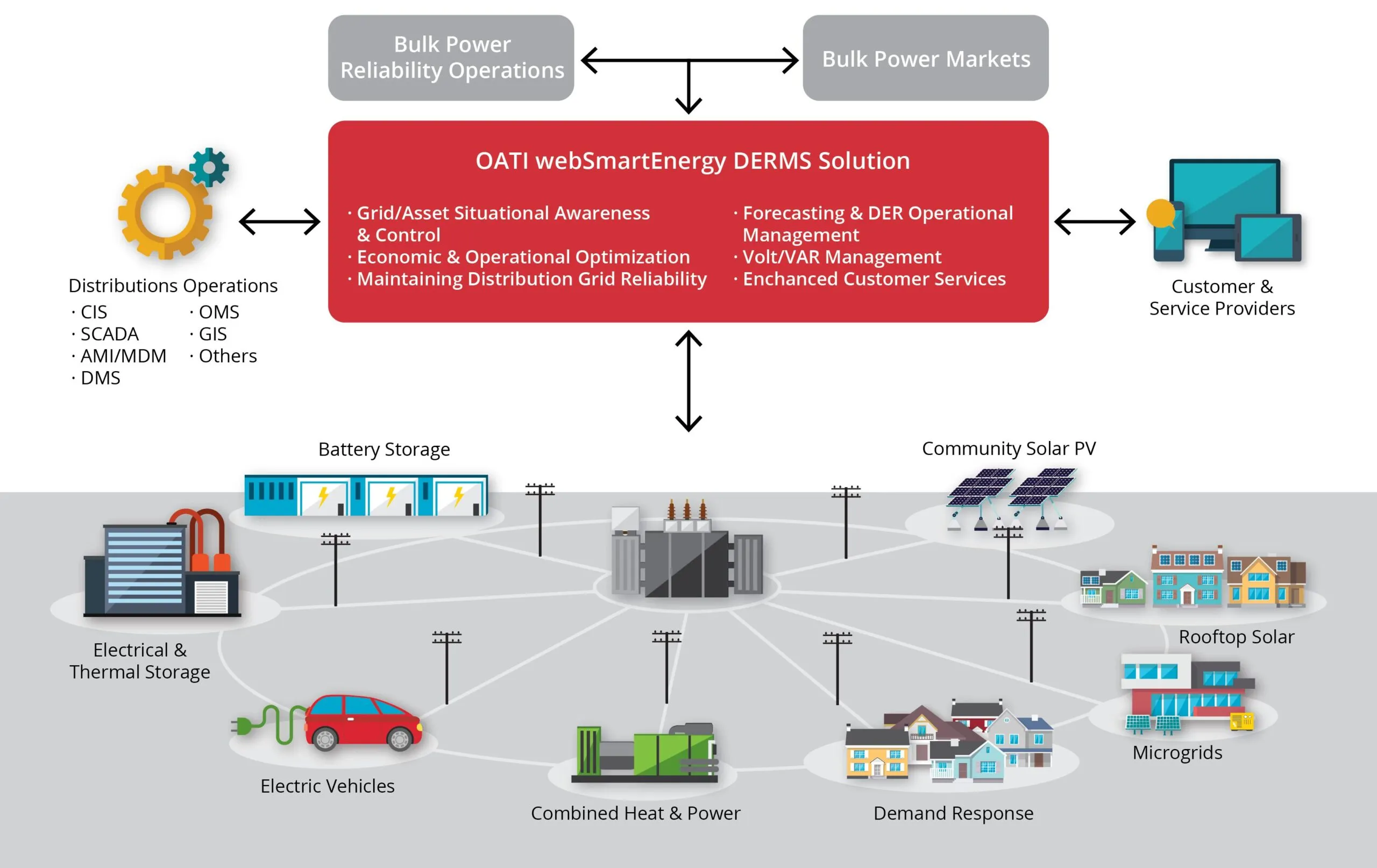
What Is Open Access Technology International DERMS?
OATI DERMS is a distributed energy resource management system for investor-owned utilities (IOUs), generation and transmission cooperatives (G&Ts) and municipal utilities. Named customers include Con Edison, TVA, the North Carolina G&T NCEMC and Dairyland Power.
The platform puts grid data from the utility’s operational systems and the enrolled DERs in one view. Dispatch is grid-aware: thermostats, inverters, batteries and EV chargers are called within configured distribution limits, so cutting the system peak does not overload a local transformer or push voltage out of range.
OATI, founded in 1995, deployed one of the industry’s first DERMS in 2009. The company says more than 250 utilities now run the platform. Verdantix, which named OATI a Leader in its Green Quadrant: DERMS (2025) report, counted more than 125 North American utility customers and about 12,000 MW of controllable capacity, with single deployments of up to 1.5 GW.
Open Access Technology International (OATI) DERMS is software for the utility that runs demand response and DER programs. Its strength is the program side: enrollment, event dispatch within distribution grid limits, settlement and wholesale market participation run on one platform, an approach Verdantix describes as program-centric.
That makes it a fit for utilities combining several programs into virtual power plants (VPPs). It is not a self-serve fleet tool for solar installers, asset owners or independent aggregators: OATI sells it to utilities under enterprise contracts, and aggregators take part through a utility’s program portal.
Pros and Cons
Pros
- Mature wholesale-market tools: S&P Global says few DERMS vendors match OATI’s market enrollment, scheduling and settlement.
- Enrollment, dispatch and settlement share one record, so program, operations and market teams use the same data.
- Proven at scale: Con Edison’s system, built with OATI, handles 50+ aggregators and 100,000 calculations every 15 minutes.
- Runs mainly in OATI’s own private data centers, so hosting and operations stay with one vendor.
- Top-ranked in the Verdantix Green Quadrant: DERMS (2025) for AI operations, user interface, DER visibility, scalability and interoperability.
- Modular: a utility can start with one thermostat program and add modules later, as Oklahoma Gas & Electric did.
Cons
- Setup is an enterprise project (technical audit, ADMS, SCADA and billing integration, a pilot), not a self-serve sign-up.
- No self-serve option for installers, asset owners or independent aggregators; it is sold to utilities.
- Grid-aware dispatch works from pre-configured limits, not a live network model; a utility still needs its ADMS for that.
- Pricing is quote-only, so budgeting has to wait for a scoping call or demo.
- Likely more platform than a small utility with one basic demand response program needs.
Features
VPP aggregation and orchestration
Builds virtual power plants, manually or automatically, from residential devices, C&I loads, generators and batteries; a VPP can supply energy or ancillary services to the wholesale market.
Real-time telemetry and control
Shows how enrolled assets perform while an event runs and sends dispatch signals to batteries and other fast-responding resources; operators can notify thousands of customers and aggregators in minutes.
Grid constraint management
A geospatial heat map with AI-assisted alarms flags overloads and voltage issues on the distribution network.
Customer engagement and enrollment
A self-service portal lets customers and aggregators check eligibility, enroll devices and track status; enrollments are validated on arrival, so only approved resources go live.
Load shape forecasting
Forecasts load up to seven days ahead, along with DER availability, so operators know where and when VPP capacity will be needed before a peak.
Market integration and settlement
Pulls real-time and day-ahead prices, submits VPP offers to the wholesale market and settles program participants against a configurable baseline that adapts when a tariff changes.
Multi-tenant architecture
One platform can serve several operating companies or member cooperatives; NCEMC runs it as a hosted DERMS for 26 co-ops.
Open Access Technology International DERMS Pricing
Pricing is not publicly listed. Quotes for Open Access Technology International DERMS come out of a scoping call or a product demo.
The platform is modular, so cost depends on the use cases a utility selects, the number of connected devices, the implementation work and the size of the service territory.
Integrations
OATI DERMS runs alongside a utility’s ADMS and other existing systems rather than replacing them:
- Utility operational systemsIntegrates with Advanced Distribution Management Systems (ADMS), SCADA, Geographic Information Systems (GIS) and AMI; a Landis+Gyr partnership puts AMI 2.0 meter data on the same record as the DER model.
- Hardware and IoTBrings IoT and SCADA data from grid-edge devices into the same view; at Dairyland Power, OATI’s IoT SCADA gateway brought a member co-op’s previously isolated battery site under DERMS control.
- Market systemsConnects directly to Independent System Operators (ISOs) and Regional Transmission Organizations (RTOs) for wholesale market participation.
- Enterprise systemsCan connect with customer relationship management (CRM) and billing software for program administration.
How to Set Up Open Access Technology International DERMS
- Request a consultation and product demo from the OATI sales team to define your utility’s specific use cases.
- Conduct a technical audit of the existing grid infrastructure and legacy IT and OT systems.
- Work with OATI engineers to design a modular implementation plan tailored to the service territory.
- Agree on hosting: OATI delivers the platform mainly from its own private, OATI-operated data centers.
- Configure program rules (when events can be called, activation constraints, settlement terms), asset hierarchies, grid constraints and the customer enrollment portal.
- Conduct field testing with a pilot group of DERs before moving to full-scale orchestration.
How to Use Open Access Technology International DERMS
Operators work from the central dashboard, which shows the distribution grid and how much aggregated DER capacity is available. When a peak is forecast, the operator builds the event on a live load curve, adding or removing programs and resources to see how the peak responds, while the system tracks how many times each program can still be called.
During the event, the software signals individual devices, for example adjusting smart thermostat setpoints or discharging home batteries, while keeping local transformers within their configured limits. The operator watches performance live and can call additional programs if the response falls short.
After the event, the platform checks meter data, flags missing readings and non-performance, and calculates each participant’s incentive. Reports show load reduction, asset performance and savings by program.
What You Can Manage with Open Access Technology International DERMS
- Virtual power plants (VPPs)
- Demand response programs
- Distribution grid reliability
- Wholesale market participation
- Customer enrollment and incentives
- Asset telemetry and performance data
- Load and generation forecasts
- Grid constraint models
FAQs
What does OATI DERMS do?
OATI DERMS lets a utility enroll customer-owned devices such as smart thermostats, batteries, solar inverters and EV chargers in demand response and VPP programs, dispatch them within distribution grid limits and pay participants for what they deliver. The same platform can bid that capacity into wholesale markets.
Who is OATI DERMS best for?
Utilities that run demand response or DER programs, mainly in North America: investor-owned utilities, municipal utilities, and cooperatives and G&Ts managing programs for their members. It is not built for solar installers, asset owners or independent aggregators looking for their own fleet software.
Is OATI DERMS free?
No. There is no publicly available free version or self-service trial. It is an enterprise solution that requires a custom contract and professional implementation.
What are the main limitations of OATI DERMS?
Pricing is quote-only, deployment is an implementation project rather than a sign-up, and the full feature set takes trained utility staff, although OATI offers a managed service for utilities that prefer not to run the stack themselves. Real-time grid support follows pre-configured thresholds rather than a live network model, a gap Verdantix sees across the DERMS market; OATI DERMS runs alongside the utility’s ADMS rather than replacing it. Its customer base is concentrated in North America.
What are the best alternatives to OATI DERMS?
Common alternatives include Schneider Electric EcoStruxure DERMS, Oracle Utilities DERMS, Siemens Gridscale X, and Itron IntelliFLEX.


