
What Is Next Kraftwerke?
Next Kraftwerke was founded in Cologne in 2009. For the units in its pool, the Next Pool, it acts as aggregator, direct marketer, power trader and balancing responsible party (BRP); owners join under a service agreement.
Its own central control system monitors and dispatches the connected units in real time. As of Q4 2025 the pool had 14,375 units and 15,541 MW of networked capacity, and the company traded 15.1 TWh in 2024. Since 2021 Next Kraftwerke has been a wholly owned subsidiary of Shell.
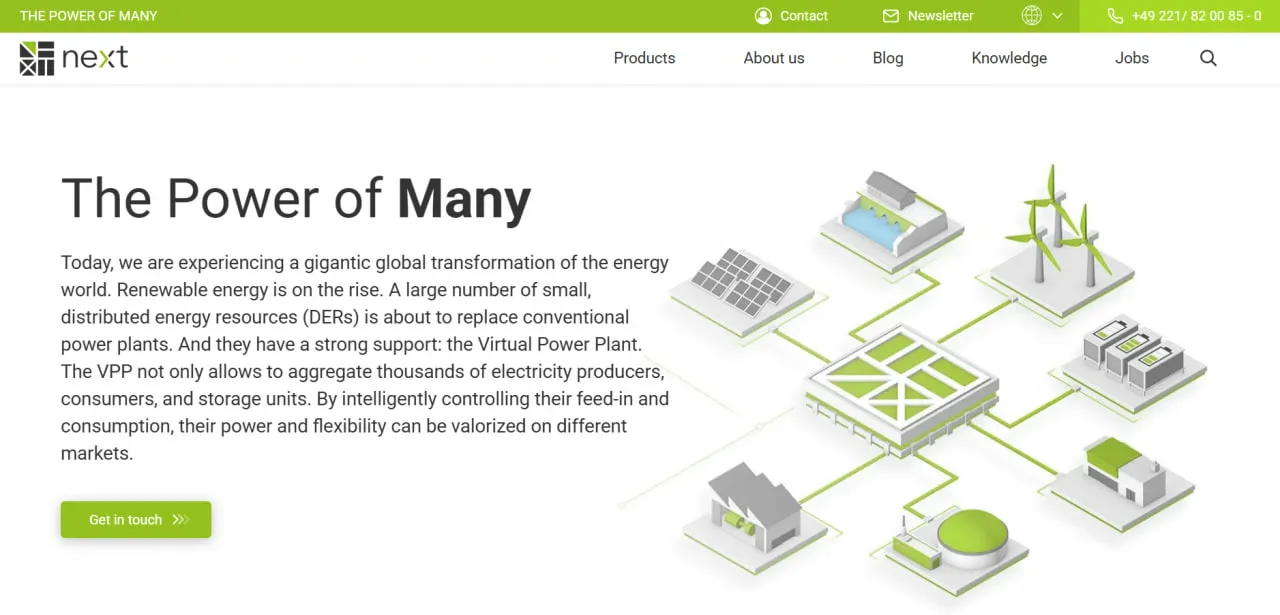
Next Kraftwerke is a German power trader and one of Europe’s largest aggregators. It links solar and wind parks, biogas and CHP plants, batteries and flexible industrial loads into a single Virtual Power Plant (VPP), sells their power on the exchanges and offers their flexibility to grid operators as balancing energy. Customers buy a service rather than software: apart from the NEXTRA trading platform, Next Kraftwerke does the trading and dispatch itself.
It suits European asset owners who would rather hand power marketing and balancing to a specialist than trade themselves. Balancing revenue goes mainly to units that can ramp on command, such as biogas, CHP and hydro plants and batteries; solar and wind parks are mostly sold on the spot markets. It is not for homeowners with rooftop PV, operators outside Europe, or plants that cannot be remote-controlled.
Pros and Cons
Pros
- Scale: one of Europe’s largest pools, with over 15 GW networked, so its forecasts draw on live data from thousands of units.
- Small flexible units such as biogas engines, CHP plants and batteries can earn balancing revenue that they would be too small to bid for on their own.
- Lower imbalance risk: traders correct over- or under-supply on the intraday market up to 5 minutes before each delivery quarter-hour.
- One contract covers the remote-control connection, trading, balancing group management and settlement.
- On request, takes over balancing responsibility and the related imbalance risk, so owners are not exposed to imbalance prices.
- One partner for mixed portfolios: 17 connected technologies, from solar, wind and hydro to biogas, CHP, batteries and industrial loads.
- NEXTRA lets utilities, BRPs and C&I consumers trade on European exchanges 24/7, via the web or an API, without their own exchange license.
Cons
- Pricing for the NEXTRA trading platform and other services is not publicly available, requiring a custom sales process.
- No VPP software to run yourself: the only self-service product is the NEXTRA trading platform, so companies building their own VPP need another vendor.
- Focused on European markets, so of little use to operators elsewhere; balancing revenue also requires remote control and TSO prequalification for each asset.
Features
Virtual Power Plant (Next Pool)
Runs generators, consumers and storage units under one control system, with 2,555 MW of aggregated flexibility available for balancing and schedule optimization.
Power Trading and Market Access
A 24/7 trading floor trades day-ahead, intraday, futures and over-the-counter (OTC) deals for asset owners, BRPs and portfolio managers.
Balancing Energy Provision
Offers FCR, aFRR and mFRR to Transmission System Operators (TSOs) from biogas, hydro and CHP plants, batteries, emergency generators and industrial loads. Owners are paid according to their unit’s contribution to grid stability.
NEXTRA Trading Platform
Software-as-a-Service for utilities, BRPs, C&I consumers, aggregators and large producers who trade themselves. It handles futures, day-ahead and intraday orders and adds a portfolio overview, forecasts of deviations and their balancing energy costs, and downloadable reports and invoices.
NEMOCS VPP Software
Software-as-a-service that Next Kraftwerke launched in 2018 for third parties building their own Virtual Power Plants; it is no longer listed among the company’s current products.
Real-Time Monitoring and Forecasting
Combines in-house weather analyses, market data and live feed-in data from more than 10,000 pool assets into generation forecasts; better forecasts mean smaller imbalance costs.
Intelligent Dispatch
Schedules controllable assets such as biogas, CHP and hydro plants to run when day-ahead and intraday prices are high. Utility-scale batteries can be marketed under a tolling contract with fixed monthly revenue or a hybrid tolling and merchant model.
Next Kraftwerke Pricing
Next Kraftwerke typically operates on a service-based and volume-based pricing model rather than a flat monthly fee for its core VPP services.
No Free Version: There is no free version of the trading platform; the company offers webinars on its Virtual Power Plant and power markets, as well as expert consultations.
Service Fees: For asset owners joining the Next Pool, the service fee is generally based on the volume of electricity traded and the specific balancing services provided.
Market Access: On request, the company takes over balancing responsibility for its partners, including the associated imbalance risks; it does not publish its trading or market access fees.
Software Licensing for NEXTRA: Pricing for the NEXTRA trading platform is not publicly listed; quotes are provided on request.
Connection Costs: Costs can also depend on the technology type and on the remote-control hardware, such as the Next Box, needed to connect the asset.
Integrations
- Hardware Integrations: Plants connect through the Next Box remote-control unit, which lets the control system curtail feed-in, for example at negative prices, or ramp units up. Next Box 4.0, built in-house, renews encryption certificates automatically and is designed so that plant operators can install it themselves.
- Protocol Support: Supports standard industrial communication protocols such as IEC 60870-5-104 and Modbus; the Next Box transmits data over an encrypted, closed mobile-network connection.
- Energy Exchange Integrations: Trades directly on European power exchanges, including EPEX Spot, EXAA and the EEX futures market.
- TSO Interfaces: Maintains direct technical connections with Transmission System Operators in seven European TSO areas for the delivery of ancillary services.
- API Access: NEXTRA can be used via an API as well as through its web front end, and trading orders can also be sent via a REST interface, SFTP server or secure e-mail.
How to Set Up Next Kraftwerke
- Consult with a Next Kraftwerke specialist to assess your energy asset’s technical specifications and flexibility potential.
- Undergo a technical audit to determine the necessary communication hardware, such as the Next Box, for remote control.
- Install the gateway hardware on-site and establish a secure data connection to the central control system.
- Complete the prequalification process required by Transmission System Operators for the specific balancing services you intend to provide.
- Register on the relevant trading platform, such as NEXTRA, or sign the service agreement to join the Next Pool.
- Begin automated operation, allowing the platform to dispatch your asset based on real-time market signals.
How to Use Next Kraftwerke
Pool members leave trading and dispatch to Next Kraftwerke and mostly check results in a digital dashboard: live feed-in data, historical production, balancing-market status and settlement reports. Owners of controllable assets should also check that automatic schedules respect site limits such as gas storage or minimum output.
Utilities and balancing responsible parties on NEXTRA do the trading themselves. They upload forecasts, procured volumes and metering data, check the expected deviations in their portfolio, and close open positions in the day-ahead auction or continuous intraday trading; several users can work at once. If Next Kraftwerke manages their balancing group, NEXTRA shows the work its traders do for them.
What You Can Manage with Next Kraftwerke
- Energy Portfolios: Track forecasts, trades and the resulting shortfalls or surpluses of a portfolio or balancing group in NEXTRA’s portfolio overview.
- Power Schedules: Set what the control system may do with your asset, such as the maximum number of starts and stops and its power limits.
- Grid Services: Offer frequency containment and restoration reserves once your unit is prequalified; standing by does not change how it runs until a TSO calls it.
- Market Trading: Place day-ahead and intraday orders from 0.1 MW, either yourself in NEXTRA or through the trading desk.
- Production Forecasts: Get solar, wind and load forecasts for your portfolio, whether consumption is metered or follows a standard load profile.
- Asset Health: Monitor the connectivity and operational status of remote energy units in real time.
FAQs
What does Next Kraftwerke do?
Next Kraftwerke runs the Next Pool, a virtual power plant of more than 14,000 units, and acts as power trader, direct marketer and balancing responsible party for their owners. It also offers NEXTRA, a trading platform for utilities and other market participants who want to trade on their own.
Who is Next Kraftwerke best for?
Next Kraftwerke is best for European owners of biogas, CHP, hydro, wind, solar and battery assets who want a direct marketer or balancing revenue, industrial companies with flexible loads, and utilities or BRPs that want NEXTRA for their own portfolios.
Is Next Kraftwerke free?
No, Next Kraftwerke is a professional energy service. While the company provides educational resources and consultations for free, participating in the VPP or using its trading software involves service fees or licensing costs.
What are the main limitations of Next Kraftwerke?
Prices are not published, and the service is built around European markets. Assets need remote control and TSO prequalification to earn balancing revenue. Companies that want software to run their own VPP will not find it here: NEXTRA is a trading platform only.
What are the best alternatives to Next Kraftwerke?
Common alternatives in the VPP and energy management space include Tesla for residential VPPs, Uplight (which acquired AutoGrid), Schneider Electric EcoStruxure, and large European aggregators such as Statkraft or Centrica Business Solutions.


