
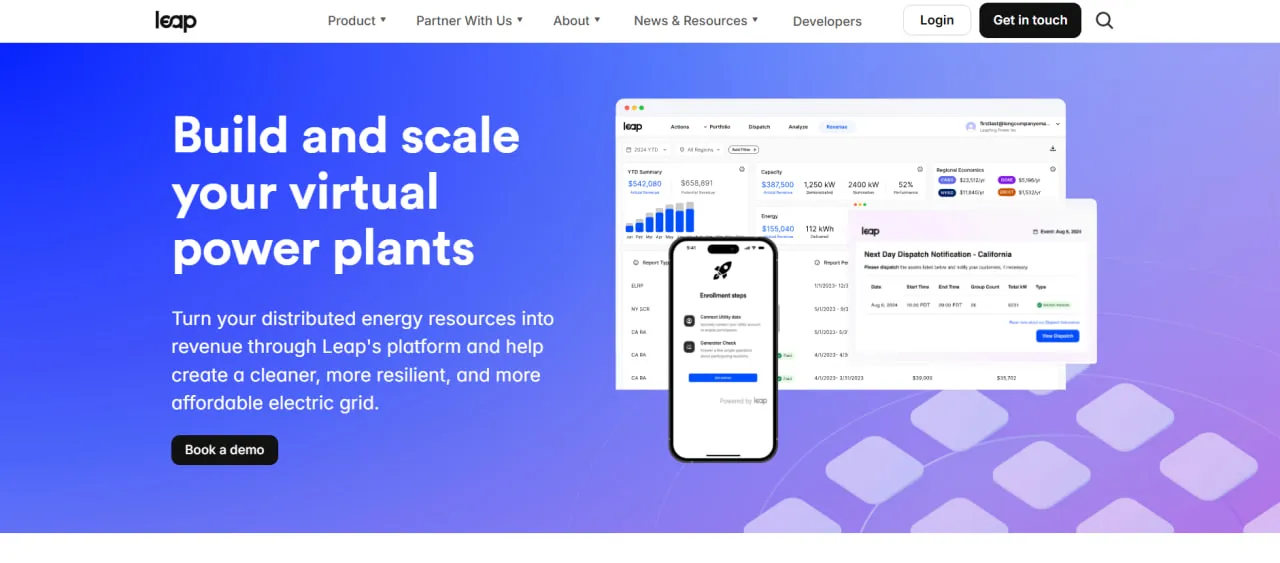
What Is Leap?
Leap is software-only, but partners do not run it as a self-service tool: Leap handles the market side for them, and they offer the result to their customers under their own brand. It installs no hardware and works with devices already connected to a partner’s cloud or energy management system (EMS).
Partners include EV charging companies, residential and commercial battery storage providers, smart building and HVAC controls providers and, more recently, data centers. Leap aggregates their devices virtually and bids the combined flexibility into demand response programs and wholesale markets.
As of August 2026, Leap says it manages more than 400,000 energy sites and devices across US energy markets and works with more than 100 technology partners.
Leap pools batteries, smart thermostats, EV chargers and building controls that technology companies already manage through their own cloud into virtual power plants (VPPs) and earns grid revenue with them in US utility programs and wholesale markets. The partner gets paid for its customers’ flexibility without building market access of its own.
It suits device makers and distributed energy resource (DER) software companies with a connected fleet in the US markets Leap covers, and there are no load minimums. It is not for homeowners or businesses signing up on their own (they take part through a partner’s app), for assets outside the US, or for utilities shopping for DERMS software to run their own programs.
Pros and Cons
Pros
- Earns grid revenue from devices a partner already controls through its cloud, with no new hardware on site.
- Proven at scale, with more than 400,000 energy sites and devices under management in US markets.
- One integration reaches every program Leap supports across its US markets, instead of a separate enrollment and integration for each program.
- Leap handles bidding and settlement, so a partner does not need an energy-trading team of its own.
- White-label model: customers enroll in the partner’s branded app, and the partner keeps the customer relationship.
- No load minimums: even very small devices can earn through aggregation, so a fleet does not have to be large to start.
Cons
- Performance-based pricing terms are not published, which makes it difficult for smaller startups to estimate margins in advance.
- Covers US markets only (California, Texas, New York, New England and PJM), so assets outside the US cannot be enrolled.
- Revenue depends on how many customers enroll and how reliably their devices respond during events.
- The partner has to build and maintain the API integration and the device-side control logic.
- Earnings depend on program rules that vary by market and utility. In California, for example, battery exports were not widely paid in grid reliability programs until Leap’s ELRP A.4 offer opened in PG&E territory in August 2026.
Features
Energy Market Access
One entry point to utility demand response programs and wholesale markets, for example ERCOT’s Emergency Response Service in Texas, California’s Demand Side Grid Support (DSGS) and ELRP programs, the Massachusetts Clean Peak Standard and PJM capacity. Leap handles bidding and program compliance.
Universal API
One interface connects batteries, thermostats, EV chargers and other device types, whatever the manufacturer, and works across all of Leap’s regions and programs.
Automated Dispatch
Sends dispatch requests (via API webhooks or polling) to the partner’s device platform or EMS, which shifts or reduces load during grid events without manual intervention. Leap never overrides site logic: the partner’s system decides how to carry out each request.
Partner-Branded Enrollment
Leap Connect, a brandable app, combines the usual multi-step utility meter authorization into a single online application. In California, Massachusetts and Texas, Auto-Enrollment also lets partners enroll devices by default under their own terms and conditions, with customers free to opt out.
Portfolio Management Dashboards
Show how many devices are enrolled, how they performed in past events and how much revenue they have earned.
Revenue-Sharing Tools
Leap settles with the grid, pays partners and provides revenue reports and API data that partners use to pay their own customers.
Grid Services Optimization
Picks the programs and times in which a fleet’s flexible capacity earns the most per kilowatt.
Leap Pricing
Pricing is not publicly listed. Leap says it charges no upfront fees and uses performance-based pricing: it gets paid only once partners start earning grid revenue.
There is no flat SaaS fee: Leap is paid out of the revenue a fleet earns in energy markets, so its income depends on the grid services the fleet actually delivers. The split is set in the partnership agreement.
Integrations
- Hardware and IoT IntegrationsConnects with smart thermostats such as ecobee and Resideo, residential batteries, EV chargers such as Wallbox, and commercial HVAC controls.
- Utility and Market IntegrationsWorks with the US grid operators (ISOs/RTOs) CAISO in California, ERCOT in Texas, NYISO in New York and PJM, and with utility programs in these regions and in New England.
- APIs and WebhooksThe API covers enrollment, meter management, dispatch, and performance and revenue reporting, so partners can run their program from their own software as well as from the Leap portal.
- Customer Onboarding ToolsConnects with utility data providers to verify customer eligibility and historical energy usage during enrollment.
How to Set Up Leap
- Schedule a discovery call with the Leap team to discuss your fleet size and target energy markets.
- Complete a technical review to ensure your hardware controls can respond to Leap’s dispatch signals.
- Sign a partnership agreement outlining the revenue-sharing or fee structure.
- Use Leap’s Universal API to integrate your device management platform with the Leap cloud.
- Launch the Leap Connect enrollment workflow for your customer base to begin aggregating assets.
- Begin participating in grid events and receiving performance-based revenue.
How to Use Leap
Day to day, a fleet manager works in the VPP dashboard, checking how many devices are online and eligible for dispatch.
When a market or utility calls a grid event, such as a demand peak, Leap sends a dispatch request and the partner’s platform automatically reduces load or discharges batteries.
After each event, the manager reviews how closely the fleet followed the signal. The same data determines what customers are paid and how the fleet is set up for future events.
Battery partners also choose how often their systems are dispatched, from emergency events only to daily real-time market participation. Settlement stays with Leap, so the partner’s team can spend its time enrolling customers and growing the fleet.
What You Can Manage with Leap
- Virtual Power Plants: Build and grow aggregations that mix different device types.
- Grid Service Revenue: Track and manage financial incentives earned from demand response, capacity and other grid services programs.
- Customer Enrollments: Track each customer from sign-up to utility authorization.
- Dispatch Performance: See how well devices responded to each grid signal.
- Market Participation: Manage the specific energy programs and geographic regions in which a fleet participates.
FAQs
What does Leap do?
Leap connects batteries, smart thermostats, EV chargers and other distributed energy resources managed by technology companies to US demand response programs and wholesale markets. It aggregates them into virtual power plants, bids their flexibility and shares the grid revenue with partners.
Who is Leap best for?
Device makers, DER software platforms and energy service companies that already control batteries, thermostats, EV chargers or building systems in the US through their own cloud and want grid revenue without building market integration software. Leap works only through such partners, so homeowners and businesses take part via a partner’s app rather than signing up with Leap.
Is Leap free?
No, Leap does not offer a free version of its platform. There are no upfront fees, though: pricing is performance-based, and Leap gets paid only once partners start earning grid revenue.
Does Leap support integrations?
Yes. Leap supports integrations with batteries, EV chargers, smart thermostats, HVAC systems, utility data providers and major US energy markets. Technology partners can connect their platforms through Leap’s APIs and webhooks.
What are the main limitations of Leap?
Leap is a software-only bridge: it does not supply hardware or manage the end-customer relationship itself. It covers only the US markets it has integrated (California, Texas, New York, New England and PJM), and partners need engineering time to connect their device platform through the API.
What are the best alternatives to Leap?
Common alternatives in the VPP and grid services market include Voltus, CPower and AutoGrid (now part of Uplight). Enel North America is often listed too, but since December 2025 it has partnered with Leap on C&I utility demand response programs. The best option depends on geographic coverage, supported asset types, fleet size and the markets you need.

