
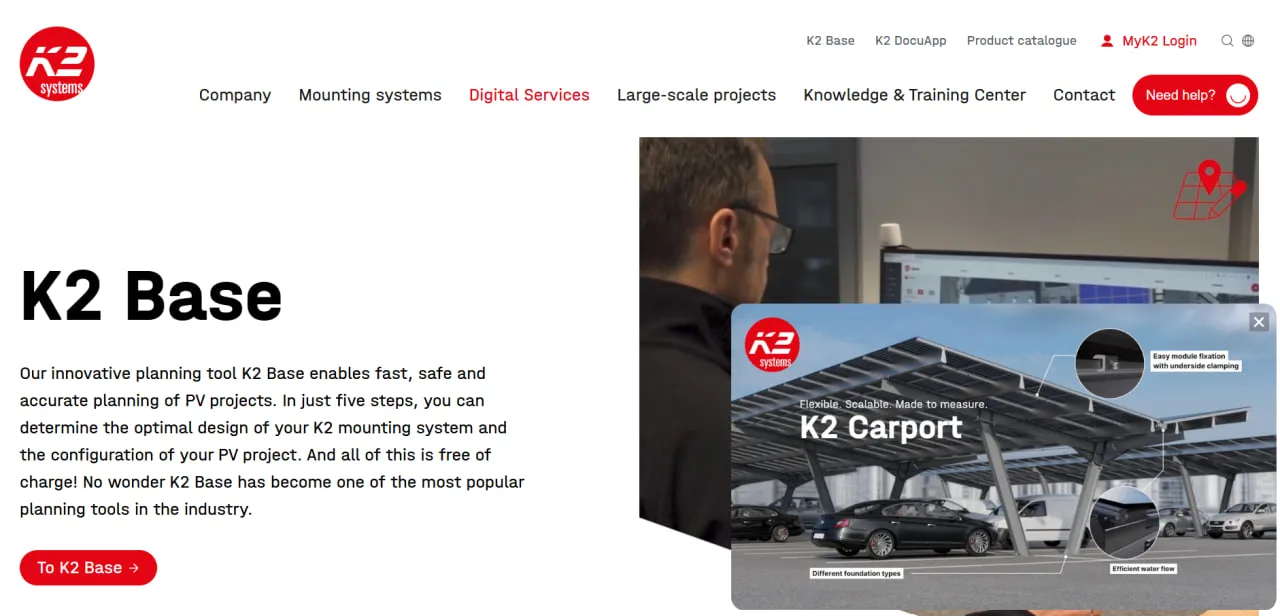
What Is K2 Base?
K2 Base is a browser-based SaaS application for planning and dimensioning PV mounting systems. It sits in the Solar Design Software category, but it covers only the mechanical side of a PV system: racking layout, roof attachment and structural verification.
Each project combines a Google Maps satellite view of the building with the roof geometry and covering, the site’s wind and snow loads, the dimensions of the chosen module and the design rules of the selected K2 system.
According to K2 Systems, the platform has more than 50,000 users worldwide. It helps professionals prepare designs that comply with applicable Eurocode standards and national requirements for structural safety and stability.
K2 Base is K2 Systems’ free web tool for working out how a K2 mounting system goes onto a specific roof: the wind and snow loads, the number and position of roof fasteners or ballast, and the full list of parts. Instead of hand calculations, which risk an over-engineered or an under-secured array, it produces a structural report and bill of materials straight from the roof drawing.
It is built for installers, project planners and structural engineers who use K2 racking on pitched roofs, flat roofs or facades. It does not handle other brands’ mounting systems or ground-mounted arrays. Work starts once the building is chosen, so the tool plays no part in site selection, and it does no electrical, yield or financial modeling.
Pros and Cons
Pros
- Free, with no subscription or per-project fees, so every quote can be run through it at no cost.
- Runs in the browser on any PC or Mac, with nothing to install.
- Produces a project-specific structural verification to the Eurocode, with loads taken from the site address, that an engineer or building authority can check.
- Through K2+, string and inverter design continues in SMA, SolarEdge, Fronius, Kostal or GoodWe tools from the same project data.
- Roofs are drawn over Google Maps satellite imagery, so a first layout can be done from the office before the site visit.
- K2 extends the mounting-system warranty from 12 to 20 years for projects planned in K2 Base, structurally verified and documented in the K2 DocuApp.
- Supports small residential rooftops and large commercial flat-roof projects.
Cons
- Works only with K2 Systems mounting hardware, so it is of no use to installers who buy other brands’ racking.
- There is no electrical or energy-yield simulation; string and inverter design is handed off via K2+ to tools such as SMA Sunny Design or SolarEdge Designer.
- A stable internet connection is required for the editor, project data, and satellite imagery.
- Users unfamiliar with structural engineering terminology or Eurocode requirements may face a learning curve.
- Ground-mounted systems are outside its scope, and custom-fabricated structures are not covered.
K2 Base Features
Google Maps Integration
Locates the building by address and lets you draw roof outlines, module fields and keep-out areas on the satellite image.
Automatic Load Determination
Automatically calculates applicable wind and snow loads based on the project location, building characteristics, and terrain category. Calculations account for relevant national annexes of the Eurocode.
Intuitive Roof Editor
You draw pitched, flat or metal roofs and set their dimensions, slopes, edges and keep-out areas; one project can hold several roofs and module fields.
Static Verification
Produces a structural analysis for each project showing how heavily the mounting system is utilized, and calculates the roof fixings. On flat roofs it works out the ballast needed against wind; since November 2026 the analysis for the D-Dome 6 system also covers module loads, insulation compression and anchors.
Bill of Materials
Automatically creates an editable list of the required K2 components, including rails, roof hooks, clamps, connectors, fasteners, and ballast elements.
K2+ Interface
Sends the project to the design tools of inverter makers and other partners, so roof and module data are not entered twice.
Multi-Language Support
Provides localized interfaces, calculation rules, and regional standards for multiple markets, making it suitable for international solar companies.
K2 Base Pricing
K2 Base is provided by K2 Systems as a free online service for its customers and professional partners.
Free Access
There is no subscription fee or upfront software cost. Users need to create a free MyK2 account to save, edit, and manage projects.
Demo and Training
K2 publishes a demo video, a tutorial that walks through a complete project in five steps, recorded webinars and an FAQ.
No Usage-Based Fees
K2 charges nothing per project, so system size, number of projects and design complexity do not change the cost.
K2 Hardware Requirement
Although the software is free, it is intended to support projects that use K2 Systems mounting hardware. The platform’s component selection and calculations are based on K2 products.
K2 Base Integrations
The K2+ interface links K2 Base with inverter makers’ design tools, electrical design software, engineering and permitting services, and project documentation. K2+ has also exchanged project data with Eturnity since January 2024, and since October 2026 projects from Aurora Solar’s Design Mode can be passed into K2 Base.
Inverter and Electrical Design Integrations
- SolarEdge
- SMA
- Fronius
- Kostal
- GoodWe
- Archelios Pro
- PV*SOL Premium
Engineering and Permitting
- GreenLancerK2+ exports the project to GreenLancer to get permitting and engineering services.
K2 Systems Applications
- K2 DocuAppImports K2 Base projects for paperless documentation on site and collects the customer’s acceptance signature on a smartphone; available for iOS, Android and as a web app.
- Site survey dataPre-planning data captured on a smartphone (location, roof pitch, obstacles) can be imported into K2 Base. Since 2022 this is done in the K2 DocuApp, which replaced the former K2 CheckApp.
How to Set Up K2 Base
- Visit the K2 Systems digital services page and open the K2 Base login.
- Create a free MyK2 account using your professional email address.
- Sign in and configure your user profile, preferred units, language, and regional standards.
- Create a new project and enter its address to open the Google Maps satellite view.
How to Use K2 Base
1. Create the Project
Enter the project and customer details and locate the building on Google Maps. In the Loads step that follows, K2 Base fills in the wind and snow loads for the address; check them before drawing the roof.
2. Define the Roof
Draw the roof geometry, specify its pitch and dimensions, and mark obstructions such as chimneys, skylights, vents, and restricted areas.
3. Select the PV Modules
Choose the required photovoltaic module from the integrated module database.
4. Select the Mounting System
Choose a compatible K2 mounting system, such as SingleRail or Dome 6; the systems offered depend on the roof type and roof covering.
5. Create the Module Fields
Position the required module fields on the roof. The software calculates the mounting layout, rail placement, attachment points, and other structural requirements.
6. Review the Structural Results
Review structural utilization, wind and snow loads, fastener requirements, and any ballast required for flat-roof systems.
7. Export the Project
Generate a PDF report, assembly plan, ballast plan, and bill of materials for procurement and installation.
What You Can Manage with K2 Base
- Project Portfolios: Organize and filter current, planned, and completed solar projects from a centralized dashboard.
- Structural Reports: Produce PDF reports with structural calculations that engineers and building authorities can check.
- Bills of Materials: Adjust the calculated quantities (changes are color-marked), then export the list to Excel or send it with one click to a participating wholesaler’s webshop cart.
- Assembly Plans: Generate visual installation drawings for teams working on the roof.
- Ballast Plans: Calculate and visualize weight distribution for flat-roof systems.
- Data Exports: Transfer project data to connected electrical design and engineering tools via K2+.
K2 Base FAQs
What does K2 Base do?
K2 Base is a web-based tool for planning photovoltaic mounting systems. It allows installers to create roof layouts, calculate wind and snow loads, verify structural stability, and generate a complete list of K2 components required for installation.
Who is K2 Base best for?
K2 Base is best suited to PV installers, project planners and engineers who use K2 Systems mounting hardware, particularly teams that must document compliance with the Eurocode. It is a professional planning tool rather than one for homeowners planning their own system.
Is K2 Base free?
Yes. K2 Base is a free service provided by K2 Systems. Users must register for a MyK2 account to save and manage their projects, but there are no standard subscription or per-project fees.
How much does K2 Base cost?
K2 Base does not have a separate software license cost. However, the resulting designs use K2 Systems mounting components, which must be purchased through K2 or an authorized distributor.
What are the main limitations of K2 Base?
The main limitation is that K2 Base only supports K2 Systems mounting hardware. It covers pitched roofs, flat roofs and (since 2025) K2 WallPV facades, not ground-mounted systems, and it has no electrical, yield or financial analysis of its own: electrical design is handed off to inverter makers’ planning tools through K2+.
What are the best alternatives to K2 Base?
The closest like-for-like alternatives are other racking makers’ planners, such as Schletter Configurator and Esdec Calculator. OpenSolar, Aurora Solar and HelioScope cover electrical design and energy yield, which K2 Base does not. Aurora and HelioScope can also feed it: in the US, K2 accepts designs from both to produce a K2 bill of materials.


