
What Is the Hybrid Optimization and Performance Platform (HOPP)?
The Hybrid Optimization and Performance Platform (HOPP) is an open-source Python package (BSD 3-Clause license) that NREL created to assess designs for distributed, commercial and utility-scale hybrid plants, mainly wind, solar and storage.
Performance runs through NREL's established models, mainly SAM (via PySAM) and, for wind wakes, FLORIS. HOPP adds the hybrid layer on top: a shared site layout, an interconnection limit, battery dispatch optimization and plant-level finance.
Wind, solar PV and batteries behind one grid connection have to be sized together: the battery absorbs two variable sources, the interconnection caps exports, and turbine wakes and shading cut yield. HOPP models these trade-offs in one simulation. It is a Python library, not an application: you describe the plant in YAML or Python and get back hourly generation, battery dispatch and project finances.
HOPP was developed by the National Renewable Energy Laboratory (NREL), renamed the National Laboratory of the Rockies (NLR) in December 2025. It suits researchers and developers who code in Python and need techno-economic screening of hybrid designs, not teams that need a graphical interface, sales proposals or CAD-level PV layouts.
Pros and Cons
Pros
- Free under a BSD 3-Clause license, so it can be used commercially and modified.
- Built by NLR (formerly NREL) on its SAM and FLORIS models, with every assumption visible in open code.
- Handles uncommon hybrids such as wave-wind or tidal-battery, not only wind-solar-battery.
- Fully scriptable, so sizing and dispatch scenarios can run in batches.
- Optimizes battery dispatch against prices with a 48-hour look-ahead, not just fixed rules, which matters for storage revenue estimates.
- Stable v3 release installable from PyPI, with Jupyter notebook examples.
Cons
- No graphical interface; studies are set up in Python or YAML.
- Built-in weather data (NSRDB, WIND Toolkit) is strongest for US sites.
- Documentation can be hard for beginners, and the small community (about 40 GitHub stars) offers little outside help.
- Large simulations require strong computing resources.
- Manual configuration is more time-consuming than commercial SaaS tools.
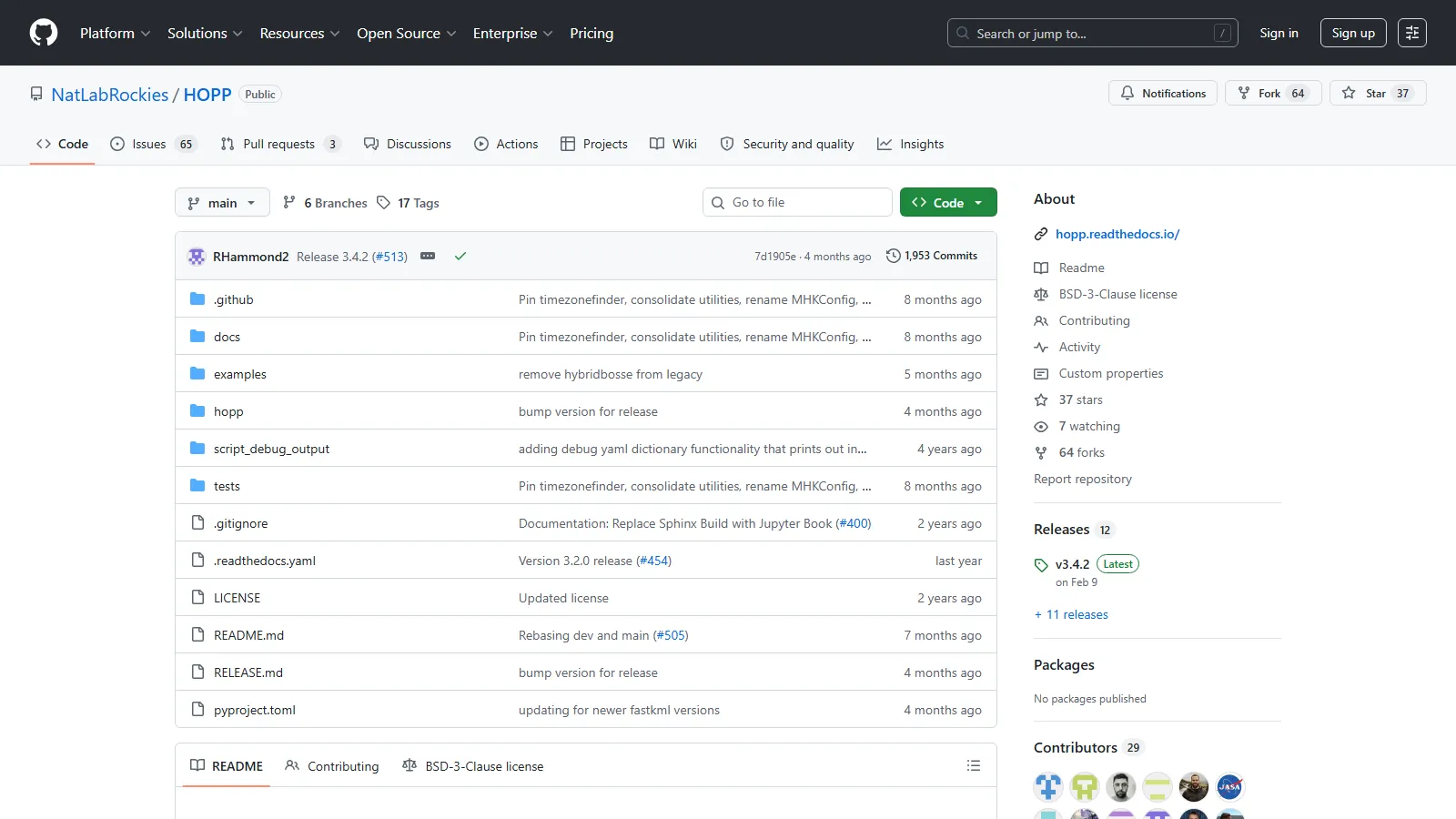
- Development has stalled: no release since v3.4.2 (February 2026), and NLR now puts its effort into H2Integrate, which has taken over HOPP's capabilities.
Features
Component-Level Optimization
Optimize turbine layouts, solar array sizing, and battery capacity.
Multi-Technology Integration
Model wind, solar PV, CSP (tower and trough), wave, tidal, battery and long-duration storage systems together, plus any other generator via a generic profile.
- Detailed Financial Modeling: Run PySAM's Single Owner model or HOPP's custom financial model from your CapEx, OpEx and PPA price.
Layout and Performance Analysis
Place turbines within a site boundary and account for wake losses and turbine shadow flicker on the PV array.
Advanced Dispatch Strategies
Optimize battery dispatch against prices with a rolling 48-hour look-ahead, or use heuristic and load-following rules.
Resource Characterization
Use NSRDB solar and WIND Toolkit wind data, or your own resource files; built-in coverage is strongest for the US.
Open-Source Python Framework
Modify the source code and script batches of runs.
Hybrid Optimization and Performance Platform (HOPP) Pricing
HOPP is free and open source, developed by NREL (now NLR) with U.S. Department of Energy funding.
Free Download: Install from PyPI; all features are included, with no license fees or paid tiers.
Open-Source License: BSD 3-Clause, which permits commercial and research use.
Infrastructure Costs: Large simulations may need more computing power, and the optional Gurobi or Xpress solvers are licensed separately; the default CBC solver is free.
Integrations
- System Advisor Model (SAM): Via PySAM, runs the PV, wind, battery, CSP, wave and tidal models and Single Owner finance.
- FLORIS: Optional wake model for turbine layout and wind farm performance, an alternative to PySAM's Windpower model.
- NREL Resource APIs: Download data for the site's coordinates with a developer API key, including BC-HRRR and Alaska WTK-LED wind data.
- ProFAST: Financial analysis tool built into HOPP's custom financial model for LCOE calculations.
- Python Ecosystem: Runs in Jupyter notebooks or plain scripts, with plants defined in YAML files.
How to Set Up Hybrid Optimization and Performance Platform (HOPP)
- Install Python 3.11 or newer.
- Install it with pip install hopp, or clone the GitHub repository.
- For a source install, add the CBC and GLPK solvers via conda (CBC is a manual install on Windows).
- Request an API key from the NLR Developer Network (formerly the NREL Developer Network) and store it with your email as NREL_API_KEY and NREL_API_EMAIL.
- Work through the example notebooks, from wind-solar-battery to tidal-battery cases.
- Run pytest tests/hopp or one example to confirm the setup.
How to Use Hybrid Optimization and Performance Platform (HOPP)
A study usually starts with a YAML file that sets the site (coordinates, boundary, resource data), each technology's size (PV kW, turbine count and rating, battery kW and kWh), the interconnection limit and financial inputs such as the PPA price.
HOPP then simulates the plant with the chosen dispatch strategy and returns hourly generation, battery dispatch, losses and financial metrics. To compare designs, you change capacities, layouts or dispatch settings and rerun, by hand or in a Python loop.
What You Can Manage with Hybrid Optimization and Performance Platform (HOPP)
- Hybrid Power Plant Layouts: Compare turbine and PV arrangements within the same site boundary.
- Techno-Economic Analysis: Compare designs by NPV, IRR, real and nominal LCOE, and benefit-cost ratio.
- Performance Simulations: Analyze hourly generation and dispatch behavior.
- Energy Loss Analysis: Quantify shading, wake, and electrical losses.
- Battery Dispatch: Optimize storage for revenue or to follow a load profile, with grid charging allowed or limited to PV for ITC eligibility.
- Sizing Scenarios: Compare technology mixes and capacity ratios for the same interconnection.
FAQs
What does Hybrid Optimization and Performance Platform (HOPP) do?
It simulates a hybrid wind, solar and storage plant at a given site, including battery dispatch and finances, so designs can be compared by output, LCOE, NPV and IRR.
Who is HOPP best for?
Researchers and project developers who code in Python and screen hybrid designs before detailed engineering. EPC and installer teams needing layouts, drawings or proposals are better served by commercial design software.
Is HOPP free?
Yes, under the BSD 3-Clause license, which allows commercial use. You pay only if you choose a commercial solver such as Gurobi or Xpress, or need more computing power for large runs.
What are the main limitations of HOPP?
It has no graphical interface, so you need Python; its built-in resource data is strongest for US sites; complex runs need heavy computing; and there has been no release since v3.4.2 (February 2026), as NLR's development has moved to H2Integrate.
What are the best alternatives to HOPP?
The closest matches are NLR's H2Integrate, which carries HOPP's capabilities forward, DTU's open-source HyDesign, HOMER and NLR's REopt. RatedPower and PVcase are commercial PV and storage design tools rather than hybrid wind-solar optimizers.


