
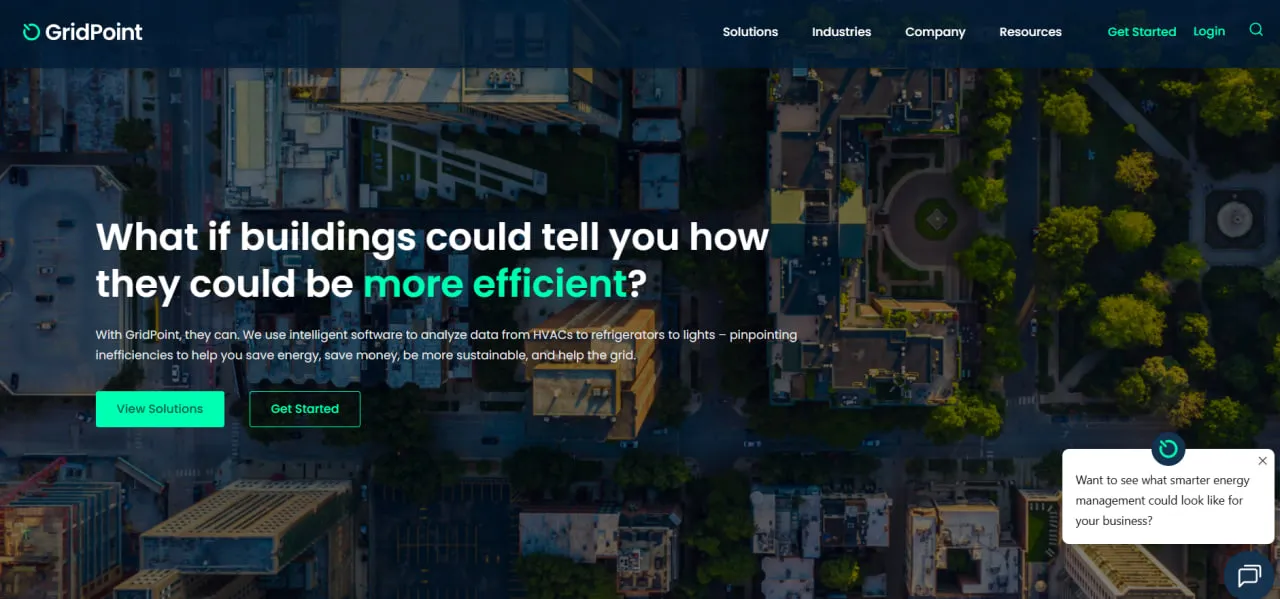
What Is GridPoint?
GridPoint is an energy management system (EMS) with building management (BMS) functions, sold to retail, food and beverage, convenience store and automotive chains, and to electric utilities that want demand-side management. It connects to HVAC, lighting and refrigeration equipment and keeps real-time and historical data for each asset. The current software is GridPoint Intelligence (web and iOS); older deployments may still run the legacy GridPoint Energy Manager (GEM).
On-site controllers and cloud software work together to detect irregularities and apply automated controls. GridPoint, based in Reston, Virginia, is deployed in over 20,000 commercial buildings; its 2022 $75M round was led by Goldman Sachs Sustainable Investing Group with Shell Ventures. In November 2026 co-founder Adrian De Luca returned as CEO, and the company began adding on-site batteries at customer sites, targeting 2 GW in total with first projects of 100–500 kW.
GridPoint installs its own controllers, meters and sensors in each store or restaurant and runs them from one cloud platform, GridPoint Intelligence. It measures energy use down to individual HVAC, lighting and refrigeration units, flags equipment that is wasting power or failing, and runs schedules and setpoints automatically, so utility costs come down without staff adjusting each building by hand.
It is built for facility and sustainability teams at chains of small and mid-sized commercial buildings, such as Walgreens, Wendy’s, Panda Express and Chipotle, where nobody can check every location in person. It is not a solar design, monitoring or finance tool and has no PV features, and it is a poor fit for a single large campus that already runs a full BMS, for homes and for industrial process loads.
Pros and Cons
Pros
- GridPoint prices the monthly fee to stay below the utility savings, so the service is meant to pay for itself.
- Equipment-level metering shows which rooftop unit or refrigeration case is wasting energy, which a utility bill cannot.
- Schedules and setpoints are set centrally, so savings do not depend on staff at each location remembering to adjust them.
- Early warnings on failing HVAC and refrigeration units let teams plan repairs instead of paying for emergency call-outs.
- No upfront capital, so a chain can equip all its sites without a capital budget request.
- The same controls can earn demand-response payments in more than 20 US markets.
Cons
- No public pricing or contract terms, so you cannot budget or compare it with other systems without going through sales.
- Every site needs GridPoint’s own controllers and sensors installed; it is not a software-only add-on.
- No public API: beyond CSV exports, getting data into your own BI or ESG tools has to be arranged with GridPoint.
- Initial setup and commissioning can be complex depending on the age of existing building systems.
Features
Real-Time Energy Monitoring
Meters consumption per circuit and per piece of equipment, so users can see which unit is drawing power at any moment.
Automated Load Control
Runs HVAC, lighting and other large loads on schedules, with optimal start and stop for HVAC, so equipment runs only when needed.
Anomaly Detection
Identifies irregularities in equipment performance, such as an HVAC unit running outside scheduled hours or consuming more power than usual.
Predictive Maintenance
Automated HVAC heating and cooling tests and asset health data show which HVAC and refrigeration units are likely to fail, so teams can repair or replace them before a breakdown.
Grid-Interactive Demand Management
Allows buildings to participate in demand response programs by automatically adjusting loads during peak price events or grid stress; during California’s 2020 grid emergency, GridPoint cut Walgreens’ load by more than 11 MW.
Customizable Reporting and Dashboards
Tracks energy use and carbon emissions; portfolio dashboards filter by site, state or date range and export every table and chart to CSV for audits and sustainability reporting.
Mobile Access
The GridPoint Intelligence iOS app gives quick access to sites, HVAC and lighting assets and critical alerts, and lets managers set temporary thermostat and lighting overrides.
GridPoint Pricing
GridPoint sells its system as Energy Management as a Service (EMaaS) and quotes every customer individually. The offer is built from these parts:
Subscription Model: One monthly fee covers the whole service; GridPoint does not publish the contract term. Since November 2026, on-site batteries are offered on the same subscription basis.
Zero Capital Down: The EMaaS approach often requires no upfront capital, covering equipment, installation, software, and ongoing service in one bundled payment.
Free Energy Analysis: GridPoint’s energy advisors offer a free energy analysis, and a three-month pilot program lets organizations try the software before committing.
Price Drivers: The quote depends on the number of sites, the amount of connected equipment and the level of analytics and control required.
There is no public price list: to get a quote, contact sales or book a demo.
Integrations
GridPoint installs its own hardware at each site (EC-series controllers, TS-series thermostats, AcuVim and AcuRev meters, refrigeration, door and duct sensors) and connects it to the equipment already in the building:
Hardware and Asset Integrations
- HVAC systems and smart thermostats, including BACnet integration with Carrier and York rooftop units.
- Lighting control panels.
- Refrigeration and kitchen equipment.
- Submeters and environmental sensors for CO2, temperature, and humidity.
Utility and Grid Integrations
- Demand response (DR) aggregators and retail electricity providers.
- Direct utility programs for load shedding, across more than 20 US demand-response markets, including ERCOT programs in Texas.
API and Data Tools
- No public API documentation; dashboard data exports to CSV, and any other feed to business intelligence or sustainability tools has to be arranged with GridPoint.
- BACnet and Modbus for collecting data from existing building automation equipment.
How to Set Up GridPoint
- Book a demo, or ask GridPoint’s energy advisors for a free energy analysis of your sites.
- Have each site assessed to specify the hardware it needs: controllers, thermostats, meters and sensors.
- Schedule installation and commissioning of the GridPoint hardware at each site.
- Access the cloud-based GridPoint Intelligence platform to set up your account and site hierarchy.
- Configure automated schedules, temperature setpoints, and alert thresholds.
- Install the GridPoint Intelligence iOS app to check alerts and set temporary overrides away from the office.
How to Use GridPoint
The day usually starts on the Executive Overview of the GridPoint Intelligence Insights Dashboard: gauges for HVAC health, active alerts and comfort score, each listing the ten worst sites. Users then open “Site Alerts”, one table of every active alert across the portfolio, sorted by severity.
Facility managers use the “HVAC Health” tab, which rates every unit as Poor, Sub-Optimal or Optimal and ranks sites on a map, to decide where to send technicians. If a site needs immediate attention, managers can set temporary HVAC setpoint and lighting overrides remotely. Sustainability teams export the underlying data to CSV to track progress toward carbon reduction targets.
What You Can Manage with GridPoint
- Energy Consumption: Real-time and historical data for every connected circuit and piece of equipment, including peak demand, power factor and 15-minute rolling averages.
- HVAC and Lighting Schedules: Automated controls that ensure systems are switched off or dimmed during unoccupied hours.
- Asset Health Records: Performance tracking that informs maintenance and replacement strategies.
- Utility Budgets: Visibility into consumption trends to help predict and manage monthly utility spending.
- Sustainability Metrics: Automated tracking of carbon emissions and energy waste reduction.
- Demand Response Events: Automated participation in utility programs that pay businesses to reduce load during grid stress.
FAQs
What does GridPoint do?
GridPoint combines on-site hardware with cloud software to monitor and control energy use in commercial buildings. It finds waste in HVAC and lighting, runs controls automatically to cut costs, and warns about equipment that is likely to fail.
Who is GridPoint best for?
GridPoint fits chains of small and mid-sized commercial buildings in retail, food service, convenience and automotive, plus utilities that use those sites for demand-side management. It suits organizations that want to manage energy across many locations from one place without upfront capital. Large single campuses with a full BMS, homes, industrial process loads and solar projects are outside its scope.
Is GridPoint free?
No. GridPoint is a paid subscription that covers on-site hardware and cloud software. It is sold with zero capital down, and according to GridPoint the monthly fee is designed to be lower than the energy savings the platform generates. There is no free trial; the entry points are a free energy analysis and a three-month pilot.
How much does GridPoint cost?
Pricing is not publicly listed because it depends on the number of sites and the complexity of the hardware required. The company uses an Energy Management as a Service model that bundles equipment and software into a monthly subscription, and it recommends booking a demo for a custom quote.
What are the main limitations of GridPoint?
Its value depends on installing GridPoint’s own controllers and sensors at every site, so it is not a software-only option. Pricing, contract terms and API documentation are not published, which makes costs hard to benchmark without the sales team and leaves CSV exports as the documented way to get data out.
What are the best alternatives to GridPoint?
Common alternatives are the building-automation suites Schneider Electric EcoStruxure, Siemens Desigo and Honeywell Forge, a better match for large buildings that already run a full BMS. For chains of small sites, specialized IoT-based energy management platforms are the closer comparison.


