
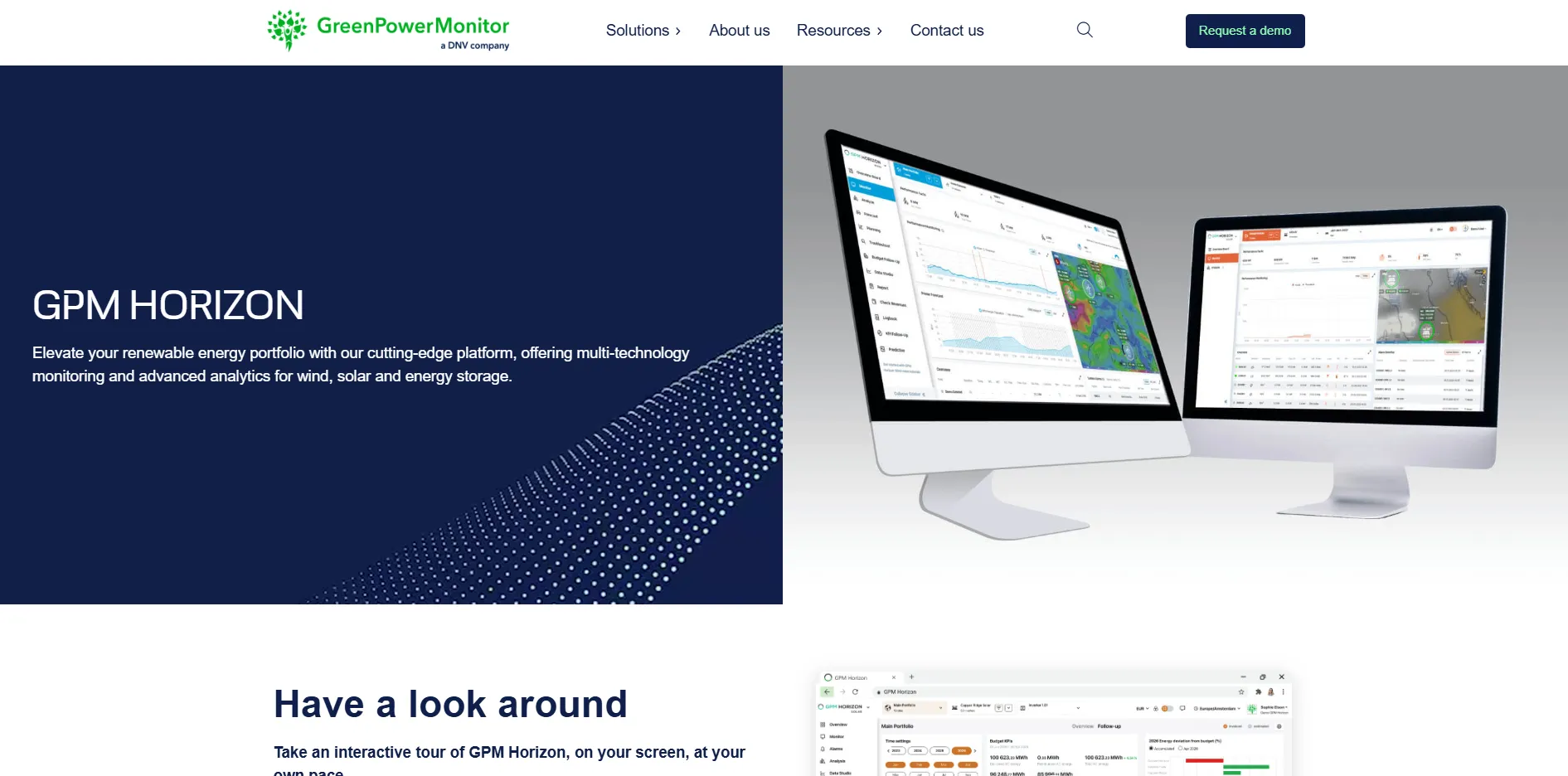
What Is GreenPowerMonitor Horizon?
GreenPowerMonitor Horizon is a cloud-based renewable energy monitoring and asset management platform developed by GreenPowerMonitor (GPM), a DNV company.
The dedicated GPM Horizon Storage module, released in October 2025, added battery energy storage (BESS) dashboards to the solar and wind coverage. Users range from Navisun, which put about 150 MWdc across 45 PV and storage assets on the platform in 2025, to Equinor, which signed a global contract for the Elite edition in December 2025 covering its onshore wind, solar and BESS portfolio. Horizon is only the cloud monitoring and asset-management layer: on-site control (GPM SCADA, the GPM PPC power plant controller, and EMS for storage and hybrid plants) is sold separately.
GreenPowerMonitor Horizon is for asset owners, independent power producers (IPPs) and O&M providers that run utility-scale solar, wind and battery storage plants, often a mix of them on equipment from several vendors. It is not aimed at residential or small C&I installers: there is no public pricing and no self-serve signup.
Its strength is that technical performance analytics and financial results sit in one place: from the Pro edition up, losses and gains are calculated in money in real time, so an asset manager sees what a fault cost, not only how many MWh it lost. Forecasts, the mobile app and predictive maintenance (the Gemini module) come only with the top Elite edition.
Pros and Cons
Pros
- Solar, wind and battery sites share one set of KPIs, alarms and reports, so a mixed portfolio does not need a separate tool per technology.
- Actual PPA revenue and contractual availability sit beside the technical data, so a performance problem can be judged by its commercial impact (Pro and Elite).
- Gemini's wind anomaly detection pairs AI with DNV's turbine domain expertise (Elite edition).
- Since April 2026 Horizon is linked to DNV's Resource Panorama, giving a traceable data record from pre-construction met masts into operation, which helps in lender due diligence.
- Gets by with less on-site hardware: soiling losses are quantified even without soiling sensors, and built-in Solcast satellite data can replace weather sensors at smaller plants that have none.
Cons
- No public pricing or self-serve signup; access starts with a sales demo and a quote.
- Learning curve for teams unfamiliar with advanced SCADA systems.
- The entry Core edition stops at monitoring, alarms and Data Studio; financial tracking and Gemini analytics mean upgrading to Pro or Elite.
- Implementation for older sites can be technically complex.
- May be overly advanced for very small renewable portfolios.
Features
Centralized Multi-Plant Management
Monitor solar, wind, battery storage and hybrid sites from one dashboard.
Predictive Analytics and AI
The Gemini module (Elite edition only) runs AI on wind turbine SCADA and CMS vibration data and maps each anomaly to its most probable failure modes; on solar plants it breaks underperformance down by loss category, from portfolio level to single devices.
Revenue and Budget Tracking
Compare production and revenue against budgets and calculate PPA revenue (Pro and Elite editions).
Alarm Management
Prioritize faults across the portfolio in every edition; maintenance ticketing comes with Pro and Elite.
Satellite Data Integration
When on-site pyranometers fail, satellite irradiance keeps performance ratio and availability calculations running; under clear skies it also serves as a reference for spotting faulty sensors.
Custom Reporting Tools
Build standardized or custom operational and financial reports with drag and drop (Reports module in Pro and Elite).
Mobile Access
Monitor technical and financial KPIs in the mobile app, included in the Elite edition.
GreenPowerMonitor Horizon Pricing
GreenPowerMonitor does not publish prices for GPM Horizon; pricing is quote-based.
Demo Access: Access starts with a live demo; you can also click through an interactive product tour without signing up.
Subscription-Based SaaS: Recurring licensing model for cloud access.
Tiered Editions: Core covers monitoring, alarms and Data Studio; Pro adds analysis, budgets, reports, revenues and tickets; Elite adds logbook, KPIs, forecasting, planning, Gemini predictive analytics and the mobile app.
Integrations
- Hardware Integrations: Supports major inverter brands, wind turbine systems, and industrial sensors.
- Data Access: Web APIs for GPM Horizon Solar and Wind let customers pull plant data into other tools; Seeq offers a ready-made GreenPowerMonitor connector.
- Cloud Infrastructure: Runs as a cloud service in the browser, with a mobile app in the Elite edition. The hosting provider is not published; for its Equinor contract, DNV states that all operational data is stored in Europe.
- External Data Providers: Solcast satellite irradiance and forecasts (Solcast is also a DNV company) are built in, and customers can add other satellite or forecast providers.
- Workflow Platforms: In Pro and Elite, tickets can be created directly in the CMMS used by the O&M team.
How to Set Up GreenPowerMonitor Horizon
- Request a consultation and platform demo.
- Complete a site and SCADA infrastructure assessment.
- Choose an edition (Core, Pro or Elite) based on portfolio requirements.
- Connect onsite hardware and communication systems.
- Configure alarms, dashboards, and user permissions.
- Launch the platform and begin live monitoring.
How to Use GreenPowerMonitor Horizon
A typical day starts with the alarm list and production KPIs to catch faults and underperforming sites. The Analysis module (Pro and Elite) then lets the team dig into inverter behavior, curtailment events and efficiency losses; in Elite, Gemini's waterfall chart traces the gap between budgeted and actual energy down to individual devices.
Finance teams use the Budgets, Revenues and Reports modules (Pro and Elite) to check actual output against budget, PPA terms and contractual availability and to report the results to investors. In Elite, weather forecasts also feed O&M planning: stowing trackers before hail or high winds, or postponing module cleaning when heavy rain is due.
What You Can Manage with GreenPowerMonitor Horizon
- Battery Storage: Track state of charge, energy throughput, cycling, round-trip efficiency and state of health, down to individual containers.
- Solar Performance: With Gemini (Elite), follow IPI (actual vs original budget), OPI (actual vs theoretical production) and device availability.
- Maintenance Workflows: Log and track tickets (Pro and Elite), and keep a plant logbook and plan O&M work (Elite).
- SCADA Data Standardization: Normalize data from mixed hardware, from individual sensors up to portfolio level.
FAQs
What does GreenPowerMonitor Horizon do?
It collects operating data from solar, wind and battery storage plants in one cloud platform, raises alarms, and turns the data into performance, loss and revenue analysis. Revenue and budget tracking start with the Pro edition; Gemini predictive maintenance needs Elite.
Who is GreenPowerMonitor Horizon best for?
Renewable asset owners, IPPs and O&M providers running utility-scale solar, wind and battery portfolios, especially mixed fleets that combine two or all three technologies. It is not built for residential or small C&I installers.
Is GreenPowerMonitor Horizon free?
No. GPM Horizon is a paid platform sold by quote, with no public price list; an interactive product tour is available without sign-up.
What are the main limitations of GreenPowerMonitor Horizon?
Core covers only monitoring, alarms and Data Studio, so budget and revenue tracking require Pro and Gemini predictive analytics requires Elite. Pricing is quote-only, connecting older sites can take integration work, BESS warranty tracking is still listed as coming soon, and the platform is likely more than a small portfolio needs.
What are the best alternatives to GreenPowerMonitor Horizon?
Popular alternatives include Power Factors, 3E SynaptiQ, Bazefield, and other enterprise renewable asset management platforms.


