
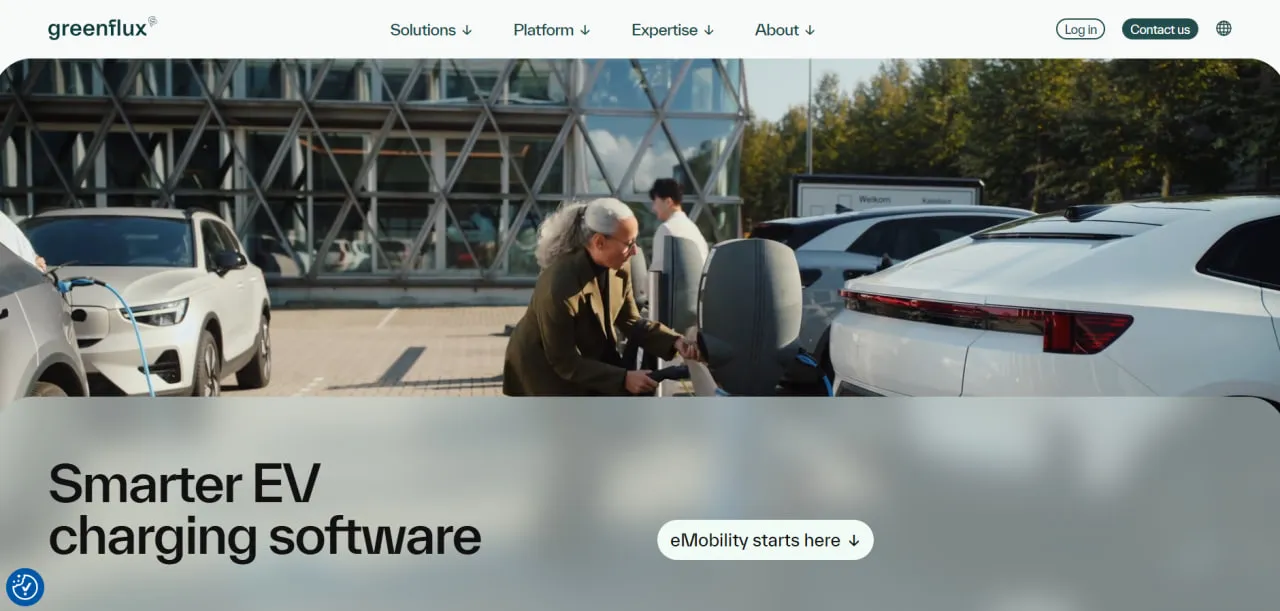
What Is GreenFlux?
GreenFlux is a SaaS charge point management platform in the EV Charging Network Management category. It is developed by GreenFlux Assets B.V., an Amsterdam company founded in 2011. DKV Mobility, a European B2B platform for on-the-road payments, bought the company in 2021 and still runs it as an independent business.
Chargers connect over the Open Charge Point Protocol (OCPP), and their status, sessions and errors come together in one dashboard from which one team can run thousands of locations. References include Equans, whose public network in Amsterdam grew from 2,500 migrated charge points to more than 4,900 in 2025, and Eneco, which moved 3,500 charge points onto the platform.
GreenFlux is a cloud back office for EV charging networks: it connects chargers from different manufacturers over OCPP, keeps their load within the grid connection, bills sessions and settles roaming. Its buyers are charge point operators (CPOs), e-mobility service providers (eMSPs), utilities, parking operators and car makers running large public, workplace or fleet networks, mostly in Europe.
It is not charging hardware, not an app for EV owners and not PV software: solar enters only as on-site production that smart charging can follow via an optional meter. Sold only through demos and custom quotes, it is a poor fit for a site host with a handful of chargers or a team that wants to try a back office before talking to sales.
Pros and Cons
Pros
- Proven at scale: 146 million charge sessions and 3.26 billion kWh since 2012 (vendor figures, March 2026).
- Smart charging fits more chargers on an existing grid connection, which can avoid a costly grid upgrade.
- Hardware-agnostic: mix charger brands or switch suppliers without changing your back office.
- Financial backing of DKV Mobility, a large European payments group, since 2021.
- Managed roaming: GreenFlux can handle roaming contracts and settlement for you.
- White-label driver app plus a 24/7 driver helpdesk under your brand (40-second average wait, per GreenFlux).
- ISO 27001-certified, with support for Eichrecht, AFIR and the UK Public Charge Point Regulations 2023, relevant to public networks and utility tenders.
Cons
- No public pricing, free trial or self-serve sign-up, so costs are unknown until a sales call.
- The deep feature set means a learning curve for new administrators, and API integrations need developer time.
- Built for large networks; likely more than a business with a handful of chargers needs.
- Roaming coverage and reference customers are concentrated in Europe and the UK.
Features
Smart Charging Algorithms
Balance 1-phase and 3-phase EVs, follow building load and on-site solar through optional meters, handle DC fast-charging hubs, and shift charging to cheaper day-ahead hours or into a virtual power plant (VPP).
Hardware-Agnostic Management
Commissions chargers from different manufacturers and runs firmware updates and charger migrations in batches from one back office.
Roaming Integration
Gives drivers access to more than 1.3 million third-party charge points, mainly in Europe, with one token or app.
Automated Billing and Payments
Flags suspicious charge detail records (CDRs) before invoicing, reimburses home charging at fixed or driver-set rates, and handles currencies and VAT across Europe.
Capacity Management
Shares grid capacity across a charger group from the cloud, with no extra load-management hardware on site, and keeps protecting the connection if the cloud link drops.
Operational Dashboard
Automatic checks fix some faults on their own and remote commands clear many others without a site visit; GreenFlux says the platform is up 99.9% of the time.
White-Label Mobile App
Charge Assist, available under the operator’s own brand, gives drivers a charger map with availability and connector filters, live session tracking, and payment by card, Apple Pay or Google Pay.
GreenFlux Pricing
Pricing is not publicly listed. Quotes for GreenFlux come out of a scoping call or a product demo.
Platforms like this are usually priced per connected charge point, sometimes per transaction, with roaming or smart charging as add-on modules, so bring your charger count and expected session volume to the demo.
Integrations
It relies on open standards: OCPP for chargers, OCPI 2.2.1 for roaming partners and ISO 15118 Plug and Charge via Hubject.
Hardware Integrations
Supports charging stations running OCPP 1.5, 1.6 and 2.0.1 and tests them in its own certification program; the certified hardware list covers more than 860 charger models from brands such as ABB, Alfen and Schneider Electric.
Roaming Integrations
Connects to the roaming hubs Hubject, GIREVE, e-clearing.net, Mobi.E and Stromnetz Hamburg, and supports direct peer-to-peer OCPI connections with other operators.
Payment Integrations
Integrates with Payter and Nayax contactless terminals and with Worldline, CCV and Ingenico terminals in Alpitronic, Siemens and Circontrol chargers; Stripe handles in-app payments, and drivers can also pay via a QR code on the charger.
API and Webhooks
A public developer portal documents APIs for CDRs, locations, sessions, remote commands, CRM, coupons, smart charging and the Charge Assist app, plus webhooks for feeding your own CRM, ERP or fleet management system.
How to Set Up GreenFlux
- Book a demo and consultation to define your network scale and required features.
- Receive a custom quote and sign the service agreement.
- Onboard your technical team to the platform through guided training sessions.
- Connect your OCPP-compliant charging hardware to the GreenFlux cloud backend.
- Configure your tariffs, roaming settings, and white-label driver interfaces.
- Launch your network and begin managing live charging sessions from the dashboard.
How to Use GreenFlux
A network operator’s day starts in the dashboard with a check for offline chargers and active error codes. Many faults can be cleared from the office with remote commands, such as a reset or a firmware update.
At peak times, smart charging profiles keep the total load within the grid connection without anyone stepping in. eMSP teams work mainly with driver accounts and tokens and track roaming transactions, so that sessions at third-party stations are billed and settled correctly. Marketing teams adjust tariffs and set promotional rates for specific locations or times of day.
What You Can Manage with GreenFlux
- Charge Point Networks: Remote control of charger configuration and status.
- Energy Loads: Capacity limits per charger group and priority charging for drivers in a hurry.
- Driver Portfolios: User accounts, RFID tokens and access permissions.
- Pricing Models: Dynamic tariffs based on time, location or session duration.
- Financial Transactions: Automated billing, invoicing, and cross-border payment settlements.
- Roaming Agreements: Connections to roaming hubs and direct peer-to-peer partners in one place.
- Uptime Reports: Analytics on station performance, energy delivered and revenue.
FAQs
What does GreenFlux do?
It runs the back office of EV charging networks in the cloud, from charger connectivity and smart charging to roaming and driver billing.
Who is GreenFlux best for?
CPOs, eMSPs, utilities, parking operators and car makers running large networks across several sites or countries, mostly in Europe, such as TotalEnergies, Q-Park and E-REDES in Portugal. It is not built for individual EV owners or a business with a few chargers.
Is GreenFlux free?
No. There is no free plan, free trial or self-serve sign-up: you book a demo with the sales team and receive a custom quote.
Does GreenFlux support all chargers?
Not automatically. GreenFlux works with OCPP chargers from many manufacturers but certifies them through its own tests. Models on its certified hardware list are known to work; others may need to pass those tests before they go live.
What are the main limitations of GreenFlux?
Prices are available only through sales, roaming coverage is centered on Europe and the UK, and chargers outside the certified list may need testing first. For an operator with a few chargers, it is more platform than the job needs.
What are the best alternatives to GreenFlux?
Common alternatives include EV Connect, AMPECO, ChargePoint and Virta. ChargePoint differs most: it also sells its own charging stations, while GreenFlux is software only.


