
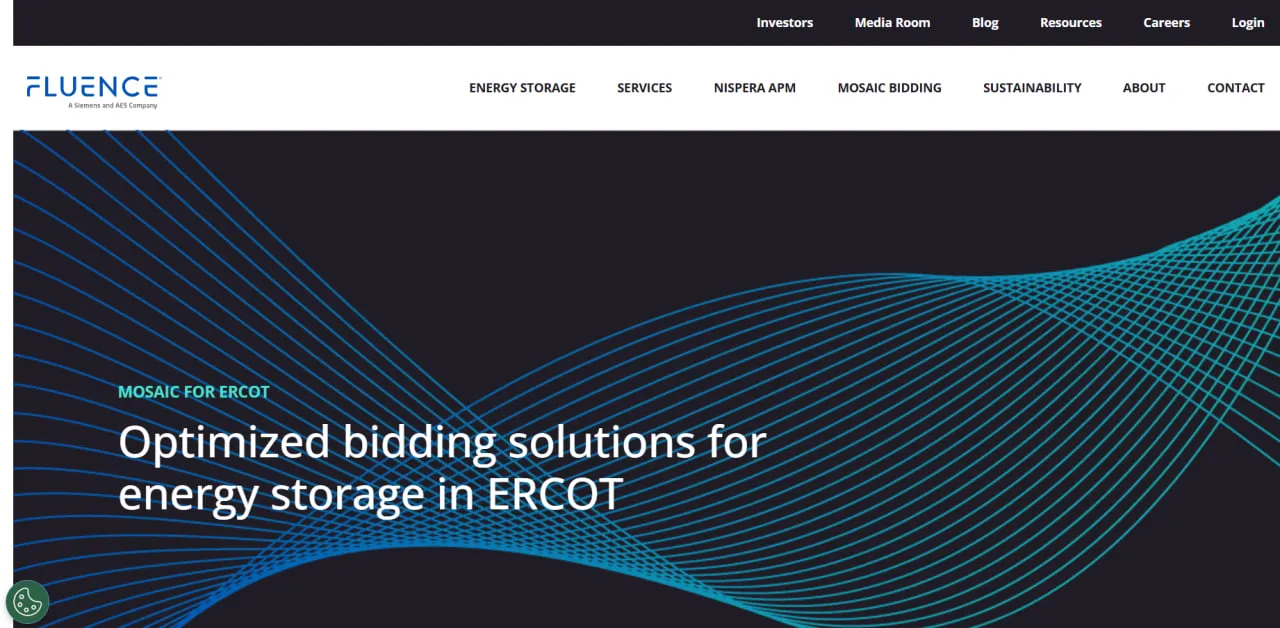
What Is Fluence Mosaic?
Fluence Mosaic is bid optimization and trading software for energy storage and renewable assets in competitive wholesale markets. It started as the AI bidding platform of Advanced Microgrid Solutions (AMS), which Fluence acquired in October 2020, and TIME named it one of the Best Inventions of 2022. Mosaic works at the market level, deciding how an asset bids; it is not a site EMS and does not replace the plant controller.
The software uses machine learning to forecast prices, supply and demand, then generates market-compliant bids that stay within each asset’s physical and warranty limits. Fluence, the storage company behind Mosaic, reports about 60 GWh of energy storage deployed, contracted or under management as of June 30, 2026; Mosaic itself counts 16 GW of assets deployed or awarded.
As wind and solar take a larger share of the grid, wholesale prices swing harder from one interval to the next. In markets that price every five minutes, a manual desk cannot rebid a battery or a solar plant fast enough around the clock, and missed price moves turn into lost revenue. Fluence Mosaic automates that bidding with AI.
It is built for independent power producers, utilities and asset managers with front-of-the-meter battery energy storage systems (BESS) and renewable or hybrid plants in Australia’s National Electricity Market (NEM), CAISO, ERCOT, MISO and Japan. Teams with their own trading desk can use the software alone; owners without one can buy Trading-as-a-Service, where Fluence trades the asset for them. It is not meant for residential or behind-the-meter C&I batteries.
Pros and Cons
Pros
- Vendor-reported revenue uplift: Fluence cites up to 50% more revenue from energy storage (based on its own analysis of battery assets in California) and up to 10% more from renewables compared with manual bidding.
- Portfolio growth does not need matching growth in trading staff: one desk can supervise many sites.
- In the NEM it rebids automatically each time asset or market conditions change, with no trader on shift needed to catch each price move.
- No need to own Fluence batteries: it bids third-party storage and renewable plants too, so one tool can cover a mixed fleet.
- Track record: 16 GW of assets deployed or awarded, 900,000+ hours of operating experience, and customers such as AES Clean Energy and Akaysha (3.6 GWh of batteries in Australia).
Cons
- No public pricing and an enterprise sales process, so smaller developers cannot estimate the cost before a scoping consultation.
- The smallest sites Fluence says it serves are about 5 MW, so residential and behind-the-meter C&I storage are out of scope.
- Complex setup process that requires deep integration with site hardware and market communications.
- Results depend on forecast quality; in unprecedented grid events the models have little comparable history, so someone must be ready to pause the algorithm and bid manually.
- Outside the NEM, bid submission to the grid operator comes only with Trading-as-a-Service, and in ERCOT only storage assets are supported.
Features
AI-Powered Price Forecasting
Machine-learning models analyze thousands of variables, from system load and transmission headroom to weather, and update price forecasts every five minutes. The forecasts are probabilistic, so bids can account for how uncertain each prediction is.
Automated Bid Submission
Creates market-compliant bid files; in Australia’s NEM it submits them directly to AEMO (or routes them to the customer’s trading desk) and rebids automatically as conditions change, while in other markets submission to the grid operator is included only in Mosaic Trading-as-a-Service.
Multi-Service Optimization
Co-optimizes energy arbitrage with ancillary services and picks the most profitable mix for each interval: all eight Frequency Control Ancillary Services (FCAS) markets in the NEM, regulation and spinning reserve in CAISO, and regulation and Responsive Reserve Service (RRS) in ERCOT.
Technology-Agnostic Integration
Optimizes batteries and renewable plants from any manufacturer, not only Fluence hardware; the asset types it can bid for depend on the market.
Constraint Management
Builds physical and contractual limits into every bid, such as state of charge, battery cycle and degradation limits, warranty terms or solar farm output caps.
Monitoring and Reporting
A user interface to view and update bidding strategies in real time, with regular reporting, 24/7 software support and quarterly strategy support from Fluence in every tier.
Mosaic Pro and Trading-as-a-Service
Mosaic Pro adds daily monitoring of your trading by Fluence market experts, with proactive recommendations. Trading-as-a-Service hands the whole job to Fluence: scheduling, bid submission to the grid operator and a regulator-compliant 24/7 control room.
Fluence Mosaic Pricing
Pricing is not publicly listed. The vendor prices each Fluence Mosaic deployment individually, once the scope is clear.
The quote is likely to depend on the megawatts under management and on the tier you choose: Mosaic software alone, Mosaic Pro or full Trading-as-a-Service.
Integrations
- Market Operator Integrations: Bid optimization for AEMO’s NEM in Australia (renewables and storage; real-time energy and FCAS), CAISO in California (storage and hybrids; day-ahead, 15-minute and real-time), ERCOT in Texas (storage only), MISO (storage, renewables, hybrid and co-located assets) and Japan’s JEPX (day-ahead and intraday). For SPP, PJM, IESO and ISO-NE, Fluence offers backcast analysis only.
- Hardware Integrations: Connects to Fluence storage products such as Smartstack and Gridstack, and to third-party BESS, wind turbines and solar inverters.
- Data and API: APIs share data with external enterprise systems and third-party asset performance management (APM) software.
- Cloud Infrastructure: Runs as a cloud-hosted platform built for large, multi-market portfolios; if your grid operator or lenders set cybersecurity requirements, confirm hosting and certifications with Fluence.
How to Set Up Fluence Mosaic
- Book a demo and consultation with Fluence to audit your asset portfolio and market requirements.
- Complete the technical integration phase, connecting the Mosaic software to your asset’s on-site control systems and market communication gateways.
- Define asset constraints, including warranty limits, degradation curves, and specific operational goals.
- Conduct simulation and shadow-bidding tests to verify algorithm performance against historical and live market data.
- Finalize user permissions and dashboard configurations for your operations team.
- Go live with automated bidding, with training and go-live support from Fluence, then track results in the regular performance reports.
How to Use Fluence Mosaic
Day to day, the job is oversight rather than manual bid entry. Asset managers open the dashboard to review current market positions and forecast revenue across the portfolio, while Mosaic refreshes its price forecasts every five minutes and updates the bids to match.
Most of the team’s time goes into checking that the strategy still fits the asset’s commercial goals and adjusting it when priorities change. If conditions shift drastically, for example during a grid emergency, operators can pause algorithmic bidding at any time and bid manually. Regular reports compare actual earnings with benchmarks, which gives the team hard numbers to show owners what automated trading adds.
What You Can Manage with Fluence Mosaic
- Automated Bidding Strategies: The rules for how each asset bids into energy and ancillary service markets, including your organization’s risk tolerance.
- Revenue Forecasts: Data-driven predictions of expected earnings based on machine learning price models.
- Asset Constraints: The warranty and operating limits that no bid is allowed to break.
- Performance Analytics: Detailed reports comparing algorithmic returns against traditional trading benchmarks.
- Multi-Asset Portfolios: A centralized view for managing a mix of solar, wind, and battery storage sites across different regions.
- Market Compliance Records: Auditable logs of all bids submitted to market operators; in the NEM, Mosaic also generates compliant rebid reasons automatically.
FAQs
What does Fluence Mosaic do?
Fluence Mosaic forecasts wholesale electricity prices with machine learning and turns those forecasts into bids for batteries and renewable plants that respect each asset’s physical and warranty limits. In Australia’s NEM it submits and rebids automatically; in other markets your own desk submits the bids, unless you buy Trading-as-a-Service and Fluence does it.
Who is Fluence Mosaic best for?
Independent power producers, utilities and asset managers with front-of-the-meter batteries or hybrid plants in the NEM, CAISO, ERCOT, MISO or Japan. Mosaic long targeted storage of about 50 MW and up; since Fluence launched Mosaic Pro and Trading-as-a-Service in 2025, it says it can serve sites as small as 5 MW. Residential and behind-the-meter C&I storage is outside its scope.
Is Fluence Mosaic free?
No. Mosaic is paid software priced by quote, and there is no free version or free trial. Fluence offers a demo and a simulation (a “test drive”) on request to show how much revenue Mosaic could earn from your assets.
What are the main limitations of Fluence Mosaic?
Coverage is uneven: outside Australia’s NEM the software does not submit bids itself, ERCOT supports storage only, and SPP, PJM, IESO and ISO-NE get backcast analysis but no live bidding. Mosaic does not monitor asset performance (Fluence sells Nispera APM for that), and it is not for residential or small commercial sites. With no public pricing and a hardware-level integration, getting started takes real time and budget.
What are the best alternatives to Fluence Mosaic?
Common alternatives in the energy bidding and optimization space include Tesla’s Autobidder, Habitat Energy, and specialized EMS providers like Stem or Wärtsilä’s GEMS platform. The choice often depends on the specific hardware being used and the geographic market of the project.


