
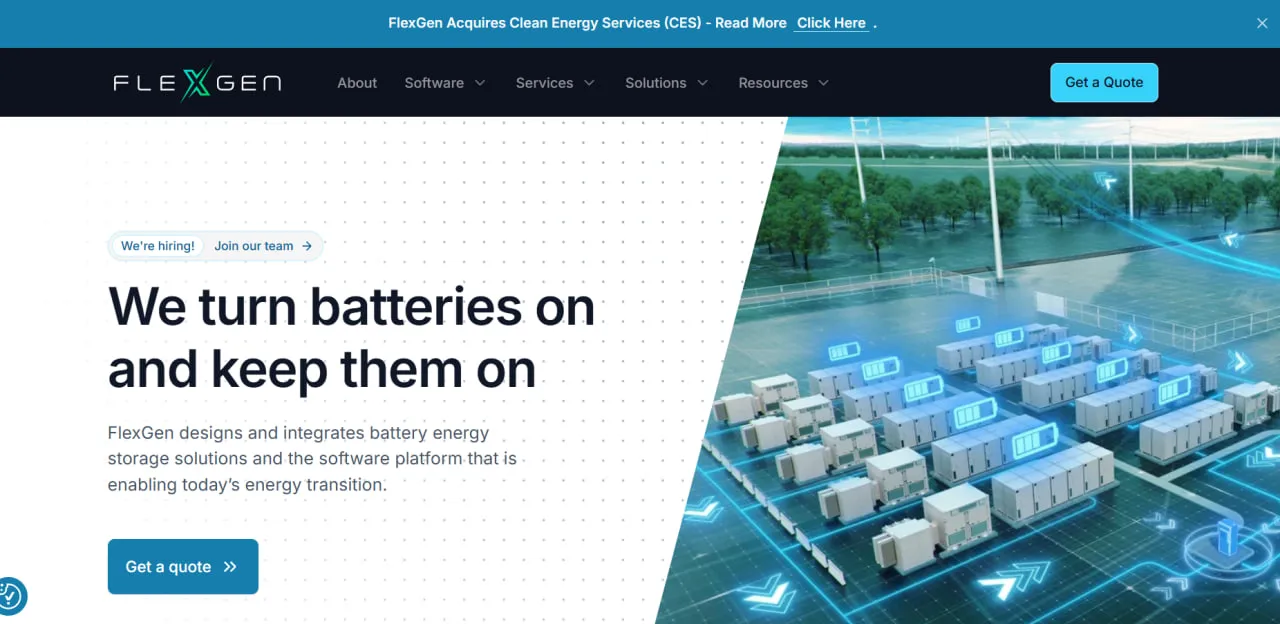
What Is FlexGen HybridOS?
FlexGen HybridOS is a hardware-agnostic Energy Management System (EMS) and power plant controller designed primarily for battery energy storage systems (BESS), with additional controls for solar-only and solar-plus-storage plants and for data center microgrids and generators. It is developed by FlexGen Power Systems, which lists developers, independent power producers (IPPs), EPCs, utilities, municipal utilities and co-ops, government agencies and data centers among its customers.
Instead of PLC logic written project by project, every HybridOS site runs one shared codebase, which FlexGen says has been refined over 13 million operating hours. At company level, FlexGen reports more than 25 GWh of storage completed and under contract and 200+ energy storage systems in more than 10 countries. That total includes the Powin fleet FlexGen acquired in August 2025, not all of which runs HybridOS.
FlexGen HybridOS is the software that runs a grid-scale battery site, from BMS and block controls up to the plant controller, with a data historian and performance analytics on top. It is aimed at owners and operators of utility-scale BESS and solar-plus-storage plants. It is not built for residential or small C&I storage, and it is more than you need if you only want monitoring without plant control.
Its strongest case is a mixed or inherited fleet: one control stack across battery and PCS equipment from different suppliers, an EMS Retrofit path for sites that started on another vendor’s system, and FlexGen’s 24/7 operations centers and field teams available to take over day-to-day asset management. The trade-offs are quote-only pricing and a setup that depends on FlexGen’s engineers.
Pros and Cons
Pros
- Strong availability record: an Orennia report cited by FlexGen put the 2023 outage rate of FlexGen-supported sites at 2% (about 98% availability), versus roughly 7% for other large integrators.
- Owners keep their choice of battery supplier at procurement and augmentation, and existing sites can switch to HybridOS through EMS Retrofit instead of staying on the original EMS.
- One PPC for solar, storage and substation equipment removes the cost of a separate plant controller or third-party SCADA on hybrid sites.
- An independent SOH calculation alongside the BMS figure gives owners their own evidence for capacity tests, augmentation timing and warranty claims.
- Site control and diagnostics keep running locally through cloud outages and resync afterwards, which matters at remote sites.
- Faster commissioning: FlexGen validates the integration in its lab before field work and says One-Touch Commissioning gets sites online 90 days faster than the industry average, though it does not publish that baseline.
Cons
- No public pricing: quotes go through FlexGen sales and often bundle software with service contracts, so the software cost is hard to compare on its own.
- Built for utility-scale plants; not a fit for residential or small C&I storage.
- Steep learning curve for teams new to EMS and SCADA operations.
- Integration with legacy hardware may require additional engineering support.
Features
Hardware-Agnostic Integration
Runs battery and PCS equipment from different suppliers under one interface, so owners can mix vendors or change suppliers at augmentation without replacing the control software.
Real-Time Monitoring and SCADA
SCADA-equivalent visibility for each site and across the fleet, backed by cloud and local data historians and, since v13, a fleet-view mobile app.
Power Plant Control (PPC)
Controls storage and solar from one PPC on solar-only and solar-plus-storage sites, including solar shedding, so the plant does not need a separate PPC or third-party SCADA.
AI-Driven Analytics (HybridOS Analyze)
A digital twin compares actual equipment behavior with modeled expectations, predictive diagnostics flag deviations before they turn into alarms or faults, and the tool puts a MWh figure on energy stranded by rack charge imbalance.
State of Health (SOH) Monitoring
Shows the BMS-reported SOH next to FlexGen’s own calculation and tracks it against degradation curves for augmentation planning and checks between annual capacity tests.
Automated Charge Limit Handler
Adjusts charging limits automatically to avoid premature battery degradation.
Remote Operations Center Support
FlexGen’s 24/7 Remote Operations Centers in Durham, NC and Houston, TX (part of its lifecycle services) respond to every site alert within 30 minutes and, with NERC GOP capability, can take operational responsibility for a site on the owner’s behalf.
FlexGen HybridOS Pricing
Pricing for FlexGen HybridOS is not publicly listed. The company typically provides custom quotes based on the scale of the energy storage project, the number of sites, and the specific modules required, such as advanced analytics or solar coordination.
FlexGen can deliver the software, lifecycle services and field support under one contract, so the HybridOS cost is often part of a larger service agreement settled through direct consultation or a request-for-proposal (RFP) process. There is no free trial; the starting point is a demo with the sales team.
Integrations
Data flows both ways: HybridOS reads and controls on-site equipment, and its cloud and local historians come with API access so owners can feed site data into their own models.
- Hardware Integrations: Works with any battery OEM; FlexGen says it has validated 80+ battery and PCS (inverter) configurations with HybridOS.
- Control Protocols: Supports industrial standards such as Modbus and native CAN bus for real-time communication between site controllers and battery management systems (BMS).
- Renewable Energy Sources: Connects solar inverters, trackers and MET stations, plus substation equipment such as capacitor banks.
- Grid Services: Follows wholesale market dispatch signals and utility dispatch systems, including automatic generation control (AGC), and provides voltage and reactive power support.
How to Set Up FlexGen HybridOS
- Bring FlexGen engineers in during design and planning to review your storage requirements and site constraints.
- Fix the hardware configuration; under One-Touch Commissioning, FlexGen validates the integration of the chosen equipment in its lab before it reaches the field.
- Coordinate on-site hardware installation and connect HybridOS to the installed equipment.
- Configure the HybridOS workspace, including site hierarchies, user permissions, and custom dashboards.
- Perform commissioning and testing to verify that communication protocols and automated controls are functioning correctly.
- Connect to FlexGen’s Remote Operations Center for 24/7 monitoring and performance optimization.
How to Use FlexGen HybridOS
An operator’s day starts on the HybridOS dashboard. The “Power Flow Panel” draws the site as a single-line diagram with power flows, breaker status, voltage, current and active faults or alarms. When something is off, the “HybridOS Analyze” diagnostics narrow it down to the incident moment, trend graphs and fault codes, which shows whether the issue can be cleared remotely or needs a field crew and leaves a record for any warranty claim.
Energy managers switch the site between market strategies as awards and grid signals change, with market prices shown in the same interface since v13. Asset and finance teams pull automated reports on revenue and battery health each month, and the SOH and augmentation forecasts feed maintenance plans and long-term financial models.
What You Can Manage with FlexGen HybridOS
- Energy Storage Portfolios: Centralized management of multiple BESS sites across different geographic regions.
- Asset Health Records: Granular data on battery degradation, state of health, and thermal performance.
- Grid Dispatch Strategies: Automated controls for responding to grid frequency signals and wholesale price fluctuations.
- Maintenance Schedules: Predictive diagnostics and augmentation forecasts that show field teams what to fix first and when capacity needs adding.
- Performance Analytics: Real-time and historical reports on energy throughput, efficiency, and revenue generation.
- Solar and Substation Controls: Integrated management of combined solar-plus-storage facilities.
FAQs
What does FlexGen HybridOS do?
HybridOS is the EMS and power plant controller for a battery or solar-plus-storage site. It dispatches batteries and inverters against market and grid signals, controls solar and substation equipment, and records site data for diagnostics and battery health analytics, for one site or a whole fleet.
Who is FlexGen HybridOS best for?
Developers, IPPs, utilities, co-ops and data center operators running utility-scale storage, especially fleets with batteries from more than one supplier, sites moving off another EMS, and owners who need controls configurable for NERC CIP.
Is FlexGen HybridOS free?
No. HybridOS is licensed under a paid, project-specific contract, often together with FlexGen’s lifecycle services, and there is no free trial.
What are the main limitations of FlexGen HybridOS?
It is built for utility-scale projects, so it is too complex and expensive for small sites, pricing is only available on request, and setup depends on FlexGen’s engineers. HybridOS dispatches against market awards and shows market prices, but FlexGen does not present it as a bidding or trading platform, so plan for a separate optimizer or trading desk if you need one.
What are the best alternatives to FlexGen HybridOS?
Common alternatives in the energy management and BESS space include Tesla Opticaster, Fluence OS, and Wärtsilä GEMS, as well as broader industrial platforms like Schneider Electric EcoStruxure.


