
What Is EV Connect?
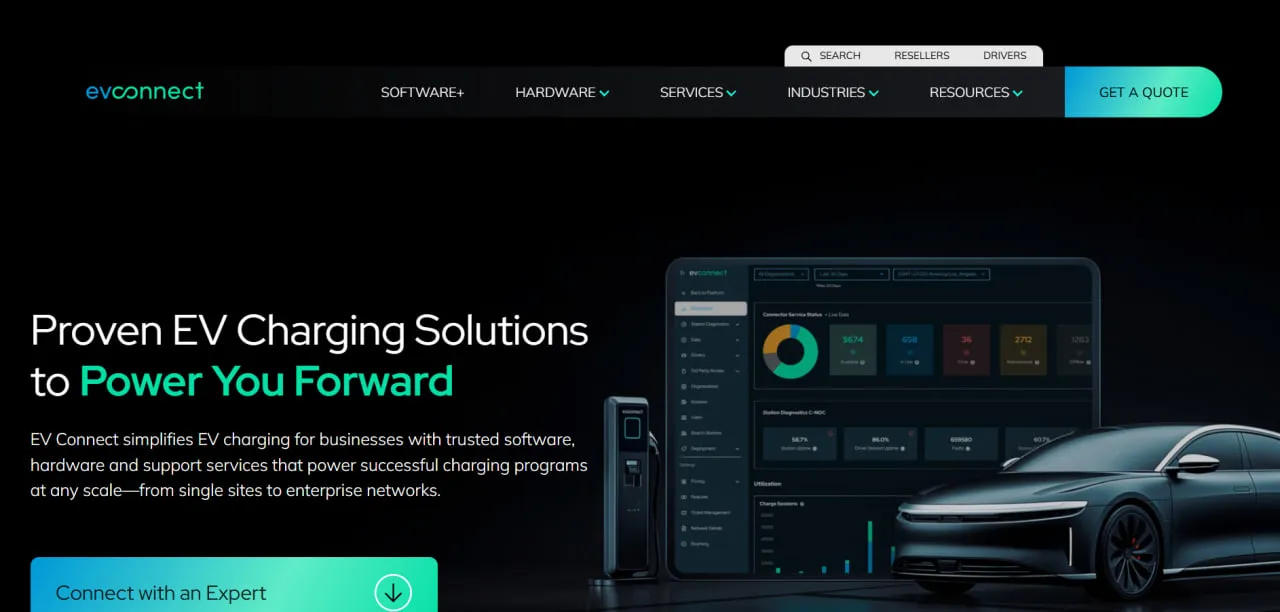
EV Connect is an Electric Vehicle Charging Management System (EV CMS), also called a Charge Point Management System (CPMS): the software that sits between the charging hardware, the utility grid and the drivers. Its users include multifamily property managers, commercial fleet operators, retail properties and utilities.
The platform connects to chargers over the Open Charge Point Protocol (OCPP). Owners use it to set prices, control who can charge, watch station health in real time and collect payments. Schneider Electric acquired the company in 2022, and Hawaii DOT's first NEVI-funded station, in Kahului on Maui, runs on EV Connect, as does the department's station at Aloha Tower.
EV Connect suits businesses in the US and Canada that run public or private EV charging across several sites and want software, chargers, driver support and repairs from one supplier. Besides the platform, the company sells Schneider Electric, PowerCharge, ZEROVA and Alpitronic chargers and runs a 24/7 call center for drivers.
It is a poor fit for a single home charger, for operators in Europe or elsewhere outside North America, and for anyone whose chargers are not on its supported hardware list.
Pros and Cons
Pros
- Adding or replacing chargers from another supported brand does not mean switching software.
- Shield turns repairs into a fixed annual cost, with parts and labor covered while the hardware warranty lasts.
- Proven at scale: the vendor reports 60,000+ charging ports deployed, 6,500+ business customers and 540 million+ kWh delivered.
- Usage and kWh reports, exportable to business intelligence tools, show which stations pay off and when prices need to change.
- Drivers get a well-rated app (4.5 stars from about 6,800 iOS ratings), app-free QR starts and a 24/7 call center, so hosts do not have to field support calls.
- A Schneider Electric subsidiary since June 2022 that also sells Schneider Charge Pro chargers, so hardware, software and support can come from one supplier.
Cons
- No public pricing: even a small site needs a sales call to compare costs.
- Initial setup can be complex, often requiring professional consultation and site audits.
- US and Canada only; operators in Europe or other markets need a different platform.
- Support is limited to a vetted list of charger brands, and Shield plans cover only new Schneider Electric, Alpitronic, PowerCharge and ZEROVA stations.
Features
Multi-Brand Hardware Management
Runs Level 2 and DC fast chargers from different makers in one network view, so a site is not locked to one charger brand. Only brands on EV Connect's vetted list are supported, not every OCPP charger.
Real-Time Monitoring and Diagnostics
Flags offline and faulted stations as they happen; the vendor says its automated monitoring resolves 70% of station issues remotely within 24 hours, without a site visit.
Automated Payment Processing
Takes payment through the mobile app, card readers and digital wallets. Hosts can price by kWh, charge time, idle time, time of day, day of week or a flat rate, set special rates for approved driver groups, and sell subscriptions or EVoucher discounts.
Load Management and Utility Integration
Caps power per station or group of stations, around the clock or on a schedule, and can share available power automatically between stations to limit peak demand charges. It also supports utility Demand Response programs.
EV Connect Shield
Paid annual protection plans, ShieldAC for Level 2 and ShieldDC for DC fast chargers, with a 24-hour SLA for remote response, technician dispatch within 3–5 business days and, on ShieldDC, annual preventive maintenance. Only new Schneider Electric, Alpitronic, PowerCharge or ZEROVA stations qualify.
Driver Mobile App
A free app for finding and reserving stations, starting sessions and paying; drivers can also start a session by scanning the station's QR code without the app. Stations are also listed on Google and PlugShare.
White-Label Solutions
Lets large enterprises and utilities run the driver app and charging service under their own brand, or build their own driver experience on EV Connect's open APIs.
EV Connect Pricing
EV Connect does not publish a price list. The software is often sold together with chargers and installation, so the total depends on project size and the service level agreements (SLAs) required. The Schneider Charge Pro bundle includes the first year of the Software+ subscription.
Quotes typically depend on:
The number of charging stations being managed.
Selection of software modules (e.g., standard management vs. white-label).
Inclusion of “EV Connect Shield” for maintenance and support.
Transaction fees for processed payments.
To get a figure, book a demo or contact sales with your site list and preferred hardware.
Integrations
Integrations rely on open standards (OCPP for chargers, OCPI for roaming) and open APIs, with prebuilt connectors for parking, fleet, billing and customer service tools such as Zendesk.
- Hardware Integrations: Supports OCPP 1.6 and later and is certified for OCPP 2.0.1 (Core and Advanced Security). Supported brands fall into three tiers: Premier (Schneider Electric, Autel, PowerCharge, ZEROVA), Standard (ABB, CMI, ICE, Wallbox) and Basic (Atom Power, BTC Power, Delta, EVSIS/Samsung).
- Payment and Roaming Integrations: Processes driver payments and manages revenue distribution for site hosts. OCPI roaming partnerships give EV Connect drivers access to 140,000+ public stations in the US and Canada, and hosts can opt in to list their stations on partner networks.
- Fleet Management Integrations: Syncs with fleet management platforms and uses RFID cards or vehicle ID (VID) to authenticate fleet charging and track vehicle usage.
- Utility Integrations: Supports utility demand response programs and connects via API to utility billing, DERMS and CIS systems.
- Installation Partnerships: Works with nationwide installers such as Qmerit for site preparation and charger installation.
How to Set Up EV Connect
- Consult with an EV Connect specialist to define network goals and select compatible hardware.
- Coordinate with certified installers (like Qmerit) to perform site preparation and hardware installation.
- Onboard the charging stations to the EV Connect cloud platform using the station IDs and OCPP configurations.
- Configure site host settings, including user access levels, pricing structures, and payment accounts.
- Launch the network and access the admin dashboard to begin monitoring live sessions.
How to Use EV Connect
Day to day, a site host works in the web dashboard: checking the network for “offline” or “faulted” alerts and resetting stations remotely when needed.
Administrators use usage reports to see which stations are most active and adjust prices when energy costs change. Fleet managers schedule charging into off-peak hours and get alerts when a vehicle may not be ready for its departure. Drivers find a charger in the app, scan its QR code to start and get an automatic receipt when the session ends.
What You Can Manage with EV Connect
- Charging Station Networks: Centralized control over multiple locations and hardware types.
- Revenue and Pricing: Custom fee structures and automated payment collection.
- Energy Consumption: Real-time tracking of kilowatt-hours (kWh) delivered across the network.
- User Access: Permission-based controls for employees, residents, or the general public.
- Maintenance Logs: Records of station health, fault history, and repair status.
- Fleet Charging: Coordination of charging schedules with vehicle duty cycles.
FAQs
What does EV Connect do?
EV Connect is cloud software for running EV charging stations. Owners use it to monitor equipment, set prices and control who can charge; drivers use the EV Connect app to find a station, start a session and pay.
Who is EV Connect best for?
Commercial property owners, multifamily housing managers, fleet operators and utilities in the US and Canada, especially those running many stations or several charger brands from one place. It is more than a single home charger needs, and it does not serve operators outside North America.
Is EV Connect free?
The mobile app is free for drivers to download, though they must pay for the charging sessions they use. For station owners and businesses, EV Connect is a paid service that requires a subscription and management fees.
What are the main limitations of EV Connect?
Prices are quote-only, so you need a sales call before you can compare costs. The platform covers the US and Canada only, supports a vetted list of charger brands rather than any OCPP charger, and Shield repair plans are limited to new Schneider Electric, Alpitronic, PowerCharge and ZEROVA stations. For a single home charger it is more than you need.
What are the best alternatives to EV Connect?
Common alternatives in the EV charging management space include ChargePoint, ChargeLab, and Blink Charging. Single-brand sites can also use the charger maker's own software, such as Tesla's or Wallbox's.


