
What Is ETAP?
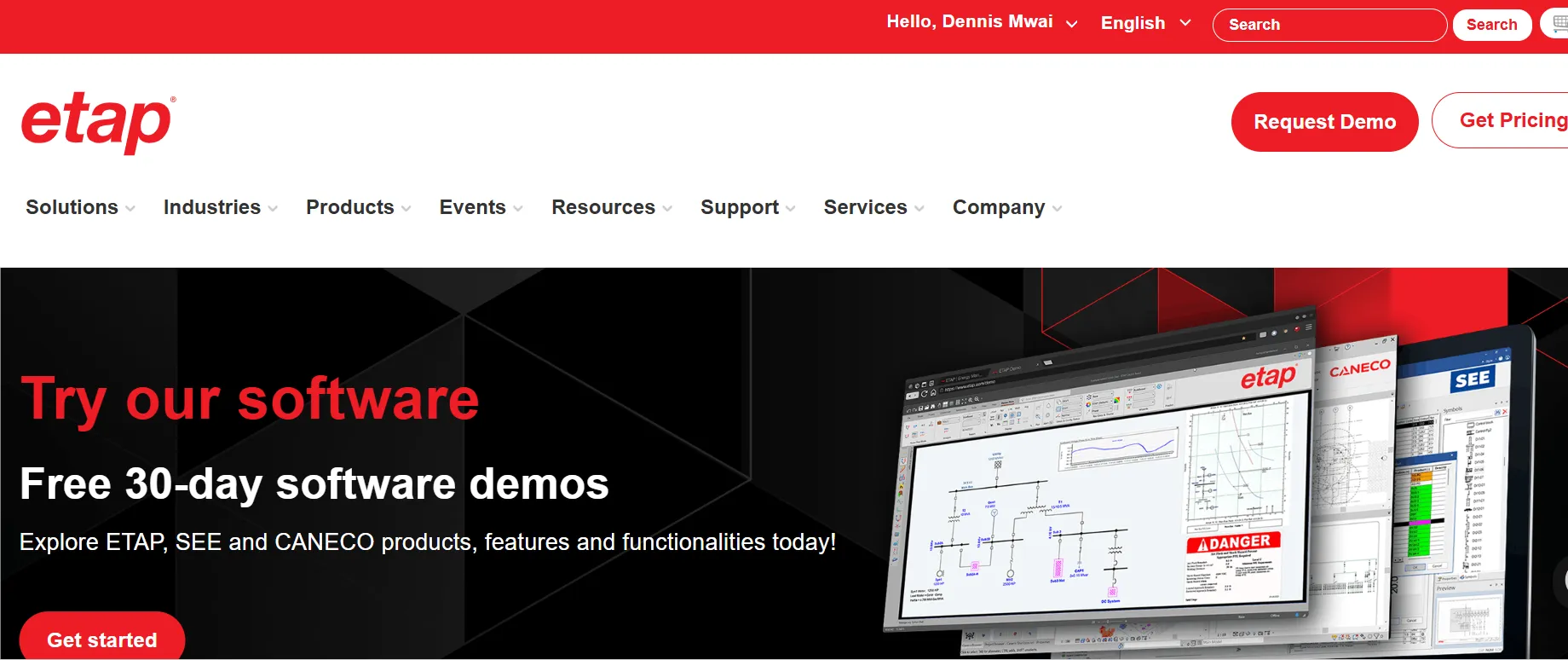
ETAP models an electrical network as a digital twin: a single-line diagram in which every cable, transformer, generator and load carries its ratings and impedances. You test switching, faults and load growth on that model instead of on live equipment.
ETAP was founded in 1986 as Operation Technology, Inc. and is based in Irvine, California. Schneider Electric took a controlling stake in 2021, but ETAP still operates as an independent vendor and reports more than 20,000 customers.
ETAP is the study software electrical engineers use to check a power system before it is built or changed: load flow, short circuit, protection, arc flash and stability on one network model. It suits utilities, industrial sites, EPCs and consultants working on large or critical systems, and its quote-only pricing reflects that.
For solar and storage, its role is the grid connection: interconnection and penetration studies for PV plants, batteries and microgrids. It is not a PV design tool (no energy-yield, shading or module-layout simulation), and residential installers will find it oversized.
Pros and Cons
Pros
- One network model serves every study, so system data is entered once
- A library of 23,000+ validated equipment models cuts manual entry of equipment data
- Works to both ANSI/IEEE and IEC standards, so one tool covers North American and international projects
- Live monitoring and prediction are available from the same vendor (eSCADA, Power Management System)
Cons
- No public prices; hard to justify for individuals or small firms
- Steep learning curve: you need power-system study experience to build a valid model and read the results
- Arc flash, stability and grid interconnection studies are paid add-ons, not part of the base bundles
- Not a PV design tool: no energy-yield, shading or module-layout simulation
Features
Each study is a separately licensed module; the pricing section shows what the bundles include.
Core analysis tools
Load flow calculates bus voltages, currents and losses and warns about overloaded transformers, cables and generators, so problems show up in the design rather than after commissioning.
Fault and short-circuit analysis capabilities
Short-circuit studies calculate fault currents and flag breakers and fuses whose ratings they exceed. ETAP follows ANSI/IEEE C37, IEC 60909, IEC 61363 and GOST R 52735, and protective device coordination uses the results to set relays so the device nearest the fault trips first.
Arc flash analysis functionality
Arc flash studies estimate the incident energy at each piece of equipment and turn it into approach boundaries, PPE requirements and labels, to IEEE 1584-2018, NFPA 70E, CSA Z462 or DGUV-I 203-077. DC arc flash, relevant for battery and PV systems, is a separate module.
Digital twin technology
In ETAP Power Simulator the digital twin is the design model, not a live system. Continuous monitoring and prediction come from the separately licensed operations products (eSCADA, ADMS, Power Management System), which run on live data and, for renewables, track solar panel and inverter performance.
Power flow and contingency analysis
Contingency analysis screens and ranks N-1 and N-2 outages and reports the resulting branch overloads and voltage violations. Optimal power flow sets generator output, transformer taps and capacitors to minimize losses or energy cost within limits. Both belong to the Transmission Planning add-on; feeder hosting capacity for new PV and other DER is in the Distribution Optimization add-on.
ETAP Pricing
ETAP publishes no prices; a quote depends on:
The product: ETAP Power Simulator for design studies, or operations products such as eSCADA.
The bundle: Launch (load flow, short circuit, cable and transformer sizing), Grow (adds protective device coordination) or Scale (adds motor acceleration, harmonics and flicker).
Add-ons: Safety (arc flash, DC networks), Sustainability (grid interconnection, microgrids, battery sizing), Reliability (stability) and Resilience (distribution optimization, transmission planning).
The subscription term: annual or multi-year.
A 30-day trial (online or desktop) needs a MyETAP account with a corporate email. It caps models at 12 AC and 10 DC buses, disables saving and data exchange, and is for evaluation only, not project work.
Integrations
Every bundle exchanges data with AutoCAD, AVEVA and Excel; Revit exchange starts at Grow. ETAP also connects to:
- GIS systems such as Esri ArcGIS, whose network data imports into ETAP (Geospatial Modeling add-on), and SCADA systems for real-time monitoring
- etapAPI, a REST API callable from any programming language
- Python scripting (etapPy) for batch studies, custom plots, Excel reports and parallel runs
How to Use ETAP
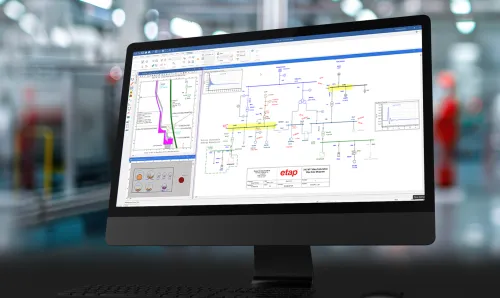
Every study follows the same loop on one network model:
- Build your system model: Draw a single-line diagram and place loads, cables, transformers, generators and, for solar projects, PV arrays.
- Input system data: Enter parameters like voltage levels, impedance, and equipment ratings.
- Choose a study type: Load flow, short circuit, arc flash, stability or any other module you license.
- Run simulations: Start the study and let ETAP calculate the results.
- Analyze results: Review reports, plots and alerts for overloaded equipment, voltage problems and overstressed protective devices.
- Optimize & iterate: Change settings or equipment and rerun until the results are within limits.
FAQs
Is ETAP good for beginners?
Only if you already understand power systems: the software assumes you know what load flow, fault and protection studies are for, and the interface takes time to learn.
What industries use ETAP?
Utilities, oil & gas, manufacturing, transportation (including rail, via the eTraX add-on) and renewable energy.
Is ETAP better than other tools?
It wins on breadth: design studies, protection, arc flash, stability and real-time operations from one vendor. If you need only a few studies, simpler tools may cost less and be quicker to learn.
Does ETAP support renewable energy systems?
Yes. ETAP models solar panels individually or as arrays, wind turbine generators and battery storage, and runs grid interconnection and PV and wind penetration studies. Its operations products add a microgrid EMS and a power plant controller.
Can ETAP run in real-time?
Yes, through ETAP’s operations products (ETAP SCADA, ADMS, Power Management System), which are separate from the ETAP Power Simulator design bundles. They monitor the live system and predict how it will respond to operator actions.
Is ETAP worth the cost?
Yes for large or critical systems such as utility-scale PV and storage plants, substations and industrial sites. For small projects it is more tool than the job needs, and add-ons such as arc flash raise the price further.
Does ETAP require coding?
No. Studies run from the graphical interface; etapPy (Python) or the REST API are only for automating batch studies or linking ETAP to other software.


