
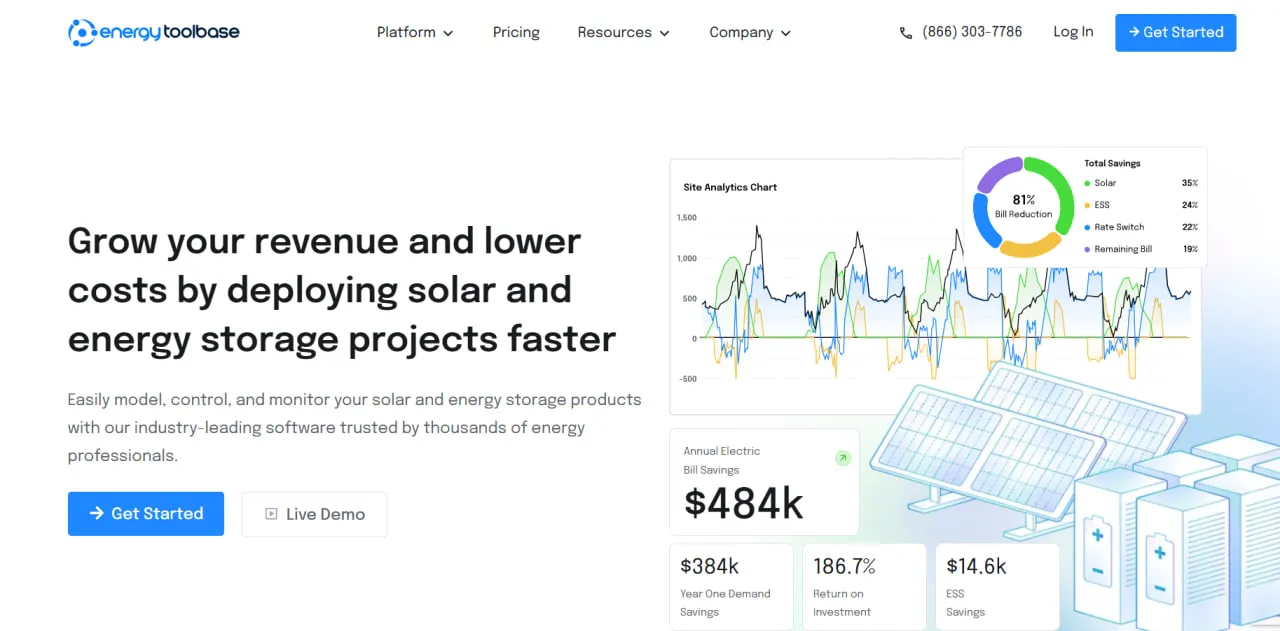
What Is Energy Toolbase?
Energy Toolbase combines solar financial modeling software with an energy management system (EMS). It is sold as four products: ETB Developer for modeling and proposals, ETB Controller for battery dispatch, ETB Monitor for real-time monitoring and savings verification, and ETB Consulting, where the vendor’s analysts run the analysis for you. Unlike general solar design tools that focus on 3D layouts, ETB Developer handles the “economic design” of a project: how much a system will save a customer under its specific tariff and load profile, and what that means for cash flow.
The vendor reports more than 1,500 client organizations, from regional installers to large EPCs and investment funds, and over 3 million proposals generated. Energy Toolbase is backed by Pason Systems (TSX: PSI), a provider of data management and control automation software for the energy industry, which acquired a majority interest in 2019 and merged its Pason Power energy storage control business into Energy Toolbase.
Energy Toolbase is for commercial and industrial (C&I) developers who must show what a solar-plus-storage project will save before a customer or lender signs. Instead of a spreadsheet with a blended electricity price, it runs the site’s interval data through the customer’s actual utility tariff and simulates how a battery cuts demand charges and shifts energy between time-of-use periods.
Beyond financial modeling, the same vendor sells the battery controls and monitoring used after commissioning, so one platform can follow a project from proposal to long-term asset management. In March 2024 Energy Toolbase added modeling that co-optimizes grid-services revenue and utility bill savings in one simulation, which the vendor describes as an industry first. It is a poor fit for residential installers who want layout and proposal in one tool, for buyers who expect self-serve sign-up and list prices, and for teams that need an API or CRM sync.
Pros and Cons
Pros
- Savings are calculated against the customer’s actual tariff from a 120,000+ rate database, not a flat $/kWh assumption.
- High institutional credibility, with lenders often requesting ETB reports for C&I financing.
- Storage models stack several value streams in one run, including demand charge savings, time-of-use shifting and grid-services or demand response revenue.
- Onboarding includes personalized training with a dedicated Account Success Manager, which shortens the learning curve.
- Every number in a proposal can be traced back to its inputs, which helps when a customer or lender questions the savings case.
- Regular updates to utility rates and policy changes, including NEM 3.0, managed by a dedicated in-house team.
- One vendor covers the project from proposal to battery dispatch (ETB Controller) and measured savings (ETB Monitor), so actual results can be checked against the original model.
Cons
- No PV layout tool, so you need a separate subscription to HelioScope, Scanifly or Solesca.
- Has a steeper learning curve than residential-focused tools.
- No published price or free trial: ETB Developer is quoted only after a demo call.
- Built-in CRM features are lightweight (leads, usage data and proposals), and there is no Salesforce or other external CRM integration yet.
- Primarily focused on the North American market, with more limited international utility rate coverage.
Energy Toolbase Features
Utility Rate Database
More than 120,000 utility rates, kept up to date by an in-house rates team, plus net metering modeling, so avoided cost and bill savings are calculated against the tariff the customer actually pays.
Energy Storage Simulation
Models how different battery brands and sizes perform for demand charge management and time-of-use shifting. Grid-services revenue, such as California’s Demand Side Grid Support (DSGS) program, can be modeled in the same run.
Professional Proposal Generation
Produces white-labeled financial reports with pro forma statements, cash flow analysis and project IRRs. Proposals can be shared as web links that notify you when the customer opens them.
Acumen EMS Integration
Connects the modeling software to ETB Controller (called Acumen EMS until its 2024 rebrand), the control system that dispatches the battery once the project is deployed. Its modes cover demand charge management, PV self-consumption, TOU arbitrage, DC clipping recapture, backup and demand response; dispatch forecasts are regenerated every 15 minutes, and AI optimization (Acumen AI) is an add-on.
ETB Monitor
A real-time dashboard for asset managers and owners that compares actual solar generation with the modeled forecast, verifies avoided cost (M&V) and breaks the utility bill down by billing cycle. Sites can be grouped into fleets and enrolled in demand response programs.
Financial Integrations
Allows users to receive instantaneous financing quotes for projects directly within the platform, streamlining the path to project funding.
Interval Data Analysis
Imports and cleans interval data from Green Button files or UtilityAPI, so the model starts from the building’s actual load profile rather than estimated usage.
Energy Toolbase Pricing
ETB Developer is a subscription, but its prices are no longer published: the vendor quotes them for your team size on a 30-minute demo call. ETB Controller and ETB Monitor have listed starting prices, with final prices quoted per project.
ETB Developer Pricing
The current pricing page lists no ETB Developer plans and asks prospects to request a quote. A subscription includes financial modeling, proposal generation and access to the utility rate database.
Previously Listed ETB Developer Prices
In June 2022 ETB Developer cost $199 per user per month, or $179 per user per month billed annually; the vendor has since stopped publishing prices.
Acumen EMS Pricing
The Acumen energy management system, now sold as ETB Controller, comes as a package that includes the ETB Control Center, a metering kit and an ETB Monitor subscription. The pricing page lists packages from $12,400, depending on battery capacity (100 kWh to 5,000 kWh), with optional add-ons and final prices quoted per project.
ETB Monitor Pricing
The vendor’s pricing page lists ETB Monitor from $4,700 for one site meter, including setup and activation, a one-year subscription, and a hardware kit; larger deployments are quoted.
ETB Consulting
ETB Consulting is a pay-as-you-go service for detailed project analysis. Its pricing is not publicly disclosed.
Free Demo
There is no free trial or free version. The only way to see the software before buying is a personalized demo call, which is also where ETB Developer is quoted.
Energy Toolbase Integrations
Energy Toolbase has no PV layout tool of its own, so in practice it is paired with one of the design platforms below; CRM and API connections are its weak spot.
Solar Design Integrations
- HelioScope
- Aurora Solar (through HelioScope, which Aurora owns)
- Scanifly
- Solesca
CRM and Workflow Integrations
- Salesforce (planned, not yet available)
Hardware and Energy Storage Integrations
- Tesla Megapack
- BYD, Socomec, Sungrow, Generac and Sol-Ark
API and Webhooks
No public API or webhook documentation is published. The documented connections are built-in imports: UtilityAPI for utility usage data, HelioScope, Scanifly and Solesca for PV layouts, and equipment libraries from storage manufacturers.
How to Set Up Energy Toolbase
- Book a demo call through the Energy Toolbase website and get a quote; there is no self-serve sign-up.
- Complete onboarding training with your Account Success Manager.
- Set up your company profile, including logos and contact information for white-labeled proposals.
- Connect your PV design tool (HelioScope, Scanifly or Solesca) so layouts can be imported into projects.
- Define standard hardware templates, including preferred solar modules and energy storage systems.
- Import your first set of utility interval data to begin modeling a project.
How to Use Energy Toolbase
A typical project starts with the site location and PV system imported from a design tool such as HelioScope. The user then uploads the customer’s interval data, for example an 8760 file, to set baseline usage, selects the utility rate schedule and adds the proposed solar and storage hardware.
Next the developer runs “what-if” scenarios, changing battery size to find the configuration with the best return on investment. Then come the financial terms (cash, lease or power purchase agreement) and the proposal itself.
For commissioned projects, an asset manager can log in to ETB Monitor to compare actual utility bill savings and system performance against the original modeled expectations.
What You Can Manage with Energy Toolbase
- Financial Proposals: Branded reports on project economics for customers and lenders.
- Utility Bill Savings: Avoided cost under the customer’s tariff, modeled before the sale and measured after commissioning.
- Energy Storage Dispatch: Battery charging and discharging on deployed sites, through ETB Controller.
- Project Portfolios: Leads, customer usage data and proposals in a basic built-in CRM, plus fleets of operating sites in ETB Monitor.
- Asset Performance: Monitor real-time energy production and consumption data.
- Financing Quotes: Access and compare project funding options from integrated partners.
Energy Toolbase FAQs
What does Energy Toolbase do?
Energy Toolbase models the economics of solar and energy storage projects against real utility tariffs (ETB Developer), dispatches batteries on deployed sites (ETB Controller) and tracks their performance and savings (ETB Monitor).
Who is Energy Toolbase best for?
Commercial and industrial (C&I) solar developers, EPCs, engineers and financiers who need detailed tariff-based savings models, especially for projects with battery storage. It is a weaker fit for residential installers who want design and proposals in one tool, and for teams that need an API or CRM sync.
Is Energy Toolbase free?
No, Energy Toolbase is a paid subscription service. The company offers personalized demonstrations of the platform’s capabilities, but it no longer advertises a free trial, and there is no free version of the software.
How much does Energy Toolbase cost?
ETB Developer is priced on request for your team size. ETB Monitor starts at $4,700 per site meter and ETB Controller packages at $12,400, with final prices quoted per project.
What are the main limitations of Energy Toolbase?
ETB Developer has no built-in PV layout tool, so designs have to come from HelioScope, Scanifly or Solesca. There is no published API and no CRM integration, prices are quoted only after a demo, and the learning curve is steeper than in simpler residential solar tools.
What are the best alternatives to Energy Toolbase?
Common alternatives include SurgePV, which offers an all-in-one design and financial platform, and Aurora Solar for residential-focused teams. For purely financial modeling, some organizations continue to use custom Excel-based tools, although these lack Energy Toolbase’s automated utility rate database.


