
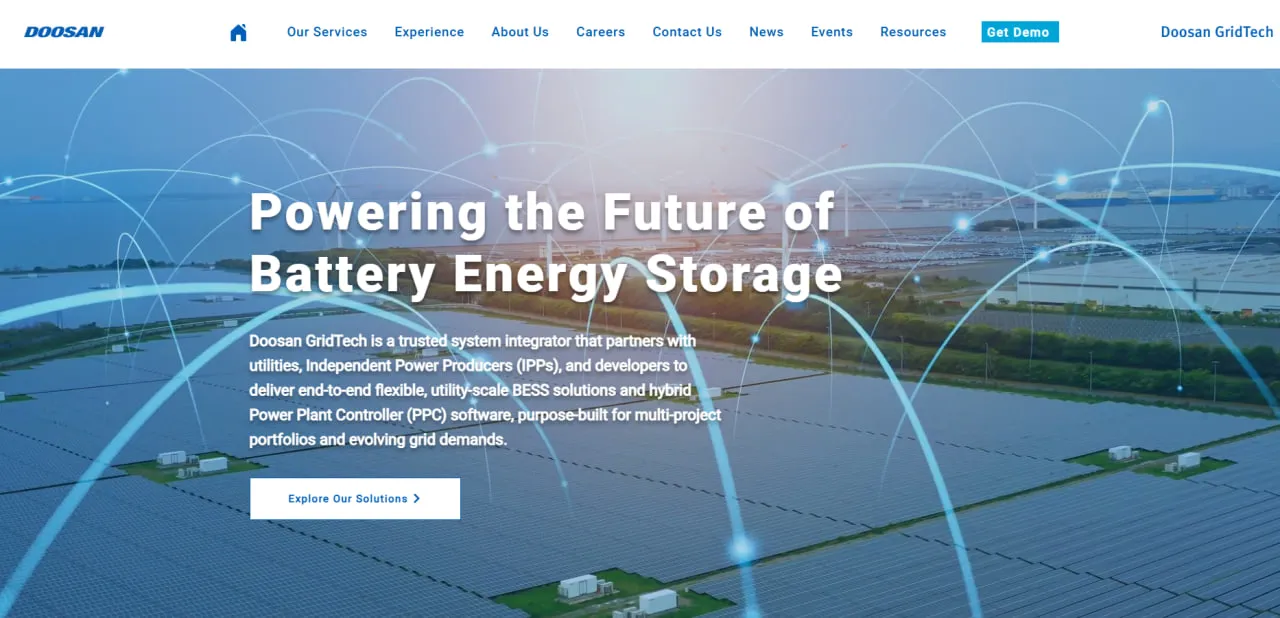
What Is Doosan GridTech DG-IC?
DG-IC (Doosan GridTech Intelligent Controller) is a software Energy Management System (EMS) and power plant controller (PPC) that works at the site level: it sets real and reactive power targets, runs frequency response and voltage regulation, and gives operators a live view of the plant. It handles AC- and DC-coupled systems and is vendor-neutral, so the batteries and power conversion systems can come from different manufacturers.
Doosan GridTech was formed in 2016, when Doosan Heavy Industries (now Doosan Enerbility) acquired Seattle-based 1Energy Systems (founded 2011), and has delivered dozens of installations totalling nearly 1 GWh across the Americas and Asia-Pacific. In November 2026 its sell-side adviser announced the sale of Doosan GridTech to an undisclosed strategic buyer, so ownership and branding may change.
Doosan GridTech is mainly a battery energy storage system (BESS) integrator: it designs utility-scale battery and hybrid plants, buys the batteries and inverters from vendors the owner selects, commissions the site and maintains it under long-term service agreements. DG-IC, the Intelligent Controller reviewed here, is the in-house power plant controller it ships with those projects.
The fit is utilities, IPPs and developers building grid-scale storage, from standalone batteries to solar-plus-storage sites and utility microgrids, who want one company accountable for both the integration and the controls. Residential, small commercial and off-grid home systems are outside its scope.
Pros and Cons
Pros
- Vendor-neutral: you choose battery and PCS suppliers project by project instead of being tied to one manufacturer's controller.
- Rated for plants up to 800 MWh and proven on 100 MW/200 MWh sites such as Neoen's Capital BESS in Australia.
- Sub-second response to real and reactive power, voltage and frequency variations helps meet strict grid requirements.
- Open MESA, SunSpec and DNP3 interfaces let owners add storage or other DER assets later without one-off integrations for each new device.
- Controller HIL (C-HIL) testing in the vendor's Typhoon HIL lab catches configuration problems before site work; the vendor says it cuts commissioning time by 25-50%.
- Field-proven on hybrid plants and utility microgrids, from Vena Energy's Tailem Bend II hybrid in South Australia to Duke Energy microgrids that island during outages.
- Long track record: the first DG-IC was installed at a utility substation in 2013.
Cons
- Built for large utility and industrial projects; not suitable for small businesses.
- No public pricing, so even a rough budget needs a quote from sales.
- Implementation requires significant specialized engineering and site-specific configuration.
- Mostly sold with Doosan GridTech's own integration and service contracts; a software-only license for a plant built by another integrator is a custom deal.
- Ownership is in transition: a sale of Doosan GridTech to an undisclosed strategic buyer was announced in November 2026, so branding and roadmap may change.
Features
Real-Time Power Plant Control
Prioritized operating modes respond in under a second to changes in real and reactive power, voltage and frequency.
Hybrid System Optimization
Runs solar-plus-storage plants with modes for power firming, energy shifting and generation following.
Scheduling and Custom Modes
Modes can run together on pre-defined schedules, and you can write your own mode and plug it in through a secure API.
Warranty and SOC Tracking
Charts battery performance against the manufacturer's warranty limits, and a state-of-charge constraint engine keeps dischargeable capacity steady over the system's life for contract compliance.
Advanced Configurability
Over 30 operating modes, including Volt/VAr, Volt/Watt, Frequency/Watt, AGC, spinning reserves, peak shaving and demand charge management, prioritized by the system owner.
OneUI Dashboard
Human-machine interface for field operations, with configurable alarms for every system component and access levels set by user role.
Safety and Security
Secure monitoring and control with a constraints engine, maintenance mode, three-tier alarms, failsafe shutdown and optional controller failover; software updates come with the long-term service agreement.
Doosan GridTech DG-IC Pricing
Pricing is not publicly listed. Doosan GridTech is quoted per deployment, so the number depends on what the sales team scopes with you.
Because DG-IC usually ships as part of a utility-scale integration project, the cost generally follows the size of the installation (MWh), the complexity of the site integration and the scope of the long-term service agreement.
Integrations
- Hardware Integrations: Reference projects pair DG-IC with batteries from Samsung SDI, CATL, LG Chem and Gotion plus a vanadium flow battery, and with PCS from SMA, Power Electronics, Parker Hannifin, Ingeteam and Siemens.
- Industrial Protocols: Modbus between devices inside the plant and DNP3 to utility SCADA, following the open MESA and SunSpec specifications.
- Analytics Tools: Integrates directly with Doosan GridTech Performance Analytics (DG-PA), powered by TWAICE, for long-term health tracking and degradation modeling.
- Cloud Services: The controller can be hosted on-premises, in the cloud or as a hybrid of both, with local, remote or automatic control.
How to Set Up Doosan GridTech DG-IC
- Consultation and Site Audit: Doosan GridTech engineers define the use cases and grid requirements, then size and model the system in a preliminary design.
- Hardware Selection and Procurement: The owner picks battery and inverter vendors; Doosan GridTech buys the equipment and checks that it works together.
- Controller Hardware-in-the-Loop (C-HIL) Simulation: Run the site's controller configuration against grid rules and operating scenarios on Typhoon HIL equipment in the vendor's lab in Bellevue, WA.
- On-Site Installation and Integration: Deploy the controller hardware and establish communications with all site assets.
- Commissioning and Testing: Factory and field tests confirm the plant responds correctly to grid signals before it goes live.
- Handover and Training: Hand the system to the operations team and sign a long-term service agreement covering performance guarantees, tuning and software updates.
How to Use Doosan GridTech DG-IC
Day to day, the controller runs on its own: it works through its scheduled operating modes and answers grid signals for frequency regulation or voltage support without an operator stepping in. Operators follow state of charge (SOC), plant output and alarms in the OneUI interface and switch to local or remote control when needed.
Asset managers work from the alarm history and the built-in performance analysis module, where they can set up custom KPIs, benchmarks and charts. When an alarm points to a specific battery rack, they drill down into that unit's data to find the cause and check it against the warranty limits.
What You Can Manage with Doosan GridTech DG-IC
- Energy Dispatch Logic: Control when and how much power is sent to or taken from the grid.
- Real-Time Grid Compliance: Manage voltage, frequency, and power factor to meet utility requirements.
- Battery Health and Safety: Monitor temperatures, cell voltages, and auxiliary systems to prevent failures.
- Revenue-Generating Services: Automate participation in energy arbitrage and ancillary service markets.
- Hybrid Power Flows: Balance the output of solar arrays with the storage capacity of batteries.
- Performance Analytics: Track historical data to identify trends in efficiency and degradation.
FAQs
What does Doosan GridTech DG-IC do?
It is the power plant controller for grid-scale battery and hybrid plants: it decides when the batteries charge and discharge, keeps voltage and frequency within grid limits and switches between operating modes for grid services and revenue.
Who is Doosan GridTech DG-IC best for?
Electric utilities, independent power producers (IPPs) and large-scale renewable developers, especially those that want Doosan GridTech to integrate the whole plant while mixing battery and inverter brands across their storage portfolio.
Is Doosan GridTech DG-IC free?
No. DG-IC is usually supplied as part of a Doosan GridTech system integration project or under a custom software licensing agreement, with pricing quoted per project.
Does Doosan GridTech DG-IC support integrations?
Yes, it is built on open standards like MESA and DNP3. This allows it to integrate with various battery brands, inverters, and utility SCADA systems.
What are the main limitations of Doosan GridTech DG-IC?
It is built for utility-scale storage, including utility microgrids that can island during outages, and is not intended for homes, small commercial sites or off-grid residential systems. Every deployment also needs site-specific engineering and configuration.
What are the best alternatives to Doosan GridTech DG-IC?
Common alternatives in the BESS and EMS space include Schneider Electric EcoStruxure, GE Vernova’s storage solutions, and Fluence OS. Choice often depends on existing hardware preferences and specific grid service requirements.


