
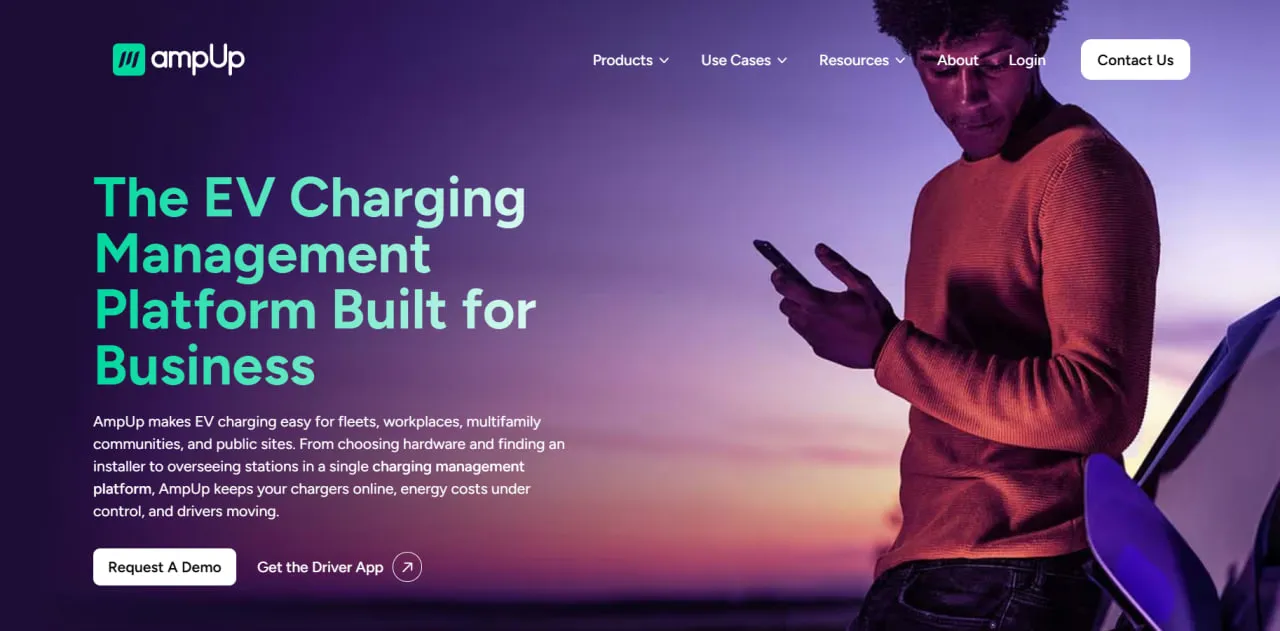
What Is AmpUp?
AmpUp is a charging station management system (CSMS) sold as software-as-a-service (SaaS). It is hardware-agnostic: it connects to OCPP-compatible stations from many manufacturers, so a host can choose chargers on price and site fit and keep the same software if it changes hardware later.
Its users are property managers, fleet operators and sustainability teams in commercial real estate, education and government, running public, private and semi-private chargers. Named customers include Hilton, JLL, CBRE, Lennar, National Grid and the Los Angeles Bureau of Street Lighting; reference sites range from six chargers at Charlotte's FNB Tower to more than 100 Autel chargers for the fleet of Mecklenburg County, North Carolina. In September 2024 AmpUp reported more than 1,000 customers and about 4% of the US commercial Level 2 charging market.
AmpUp is cloud software for organizations that host EV chargers on their own property: workplaces, multifamily buildings, hotels, fleet depots and city-owned public sites. Site managers use it to decide who can charge and at what price, to keep charging within the site's electrical capacity and to catch faulty chargers before drivers do.
Its strengths are free choice of charger hardware, access control by driver group and load management, which every plan includes in basic form. It cannot manage chargers without a network connection, and it operates only in the US and Canada. It is not solar software either: there are no PV design, monitoring or asset-management features.
Pros and Cons
Pros
- Hardware-agnostic: hosts can mix charger brands across sites and change hardware later without switching software or moving drivers to another app.
- Company-reported 99.9% platform uptime and 98.5% charging-session success rate.
- Drivers can charge without installing anything, by scanning the charger's QR code in a browser or tapping an RFID card, which suits hotels and public sites; the app is rated 4.4/5 from about 4,600 App Store ratings.
- Breaker limits and load sharing are included even in Starter, so a site can keep peak demand charges down without paying for the top plan.
- Scales from a single site to nationwide rollouts such as HelloFresh's last-mile delivery hubs, and multi-site management is included in every plan.
- Built-in kWh and CO2 reporting gives sustainability teams figures for ESG reports without a separate tool.
Cons
- Prices are not published; the latest public list prices, from hardware partner Leviton, date from October 2023.
- Starter cannot bill drivers: charging for electricity requires Core, and time-of-use rates and idle fees require Pro.
- Chargers without a network connection cannot be added, and legacy brands such as EVBox and JuiceBar get only limited support, so older sites may need new hardware.
- Demand-response income through Adapt & Earn depends on your utility running a program with AmpUp.
- Customer support for drivers has received mixed feedback regarding response times.
Features
Revenue and Pricing Management
Hosts can keep charging free or bill drivers, with payouts by direct deposit. Billing requires the Core plan; tiered and time-of-use rates, session start fees and idle fees require Pro.
Authentication and Access Control
Managers can limit chargers to groups such as employees, residents or fleet drivers, who identify themselves with the app or an RFID card. Driver groups start with the Core plan; time-based access rules need Pro.
Smart Load Management
Shares the available power among chargers so the site stays within its breaker limits and pays lower peak demand charges.
Real-Time Diagnostics
Monitors charger health and raises alerts, so operators can fix many faults remotely instead of sending a technician.
Sustainability Reporting
Tracks energy delivered (kWh), estimated CO2 savings and miles driven on electricity for internal ESG reports.
Driver Mobile App
An iOS and Android app with a map of nearby stations, reservations at sites that offer them and in-app payment.
AmpUp Pricing
AmpUp does not publish prices on its website. Plans are billed per charging port per year, plus a one-time activation fee per station, so a dual-port charger needs two licenses. The only public figures are dated: in October 2023 Leviton, one of AmpUp's certified hardware partners, listed Starter at $175, Core at $250 and Pro at $350 per port per year, plus a $100 activation fee per station, on 1-, 3- or 5-year terms. The plan levels are:
Starter: For sites that offer drivers free public charging; includes driver reservations, RFID support, remote diagnostics, analytics and multi-site management, but not revenue collection.
Core: For commercial sites; adds revenue collection with direct-deposit payouts, driver access groups, multi-user accounts and offline session management.
Pro: For high-demand hubs; adds advanced load management, time-of-use and tiered pricing, idle fees, time-based access control, fleet management and KlooBot AI diagnostics.
To get a quote, book a demo or a site assessment; the price depends on the number of ports, the plan and the contract term.
Integrations
The Open Charge Alliance has certified AmpUp for OCPP 1.6 (Full + Security, December 2024) and OCPP 2.0.1 (May 2026), the protocol chargers use to talk to management software. AmpUp also says it supports OCPI 2.2.1 for data exchange with other charging networks.
- Hardware Integrations: AmpUp lists 31 brands of Level 2 and DC fast chargers: 10 certified partners (including Autel, Leviton and Wallbox), 6 whose chargers it can take over from another network without replacing them (including BTC Power, Delta and Tritium), 12 brands verified to work over OCPP without full certification (including ABB, Alpitronic and Kempower) and 3 legacy brands with limited support (Atom Power, EVBox and JuiceBar).
- Payment Integrations: Drivers pay by credit or debit card, from an in-app wallet or with an RFID card.
- APIs: Open APIs connect charging data to fleet, telematics, property management and other business systems; for Holman, home and workplace charging feeds directly into the fleet systems that handle driver reimbursements.
- Utility Demand Response: Through its Adapt & Earn managed-charging program and OpenADR 2.0b support, AmpUp can enroll chargers in utility programs that shift charging away from peak demand hours, with incentives paid to site hosts.
How to Set Up AmpUp
- Request a site assessment or book a software demo through the AmpUp website.
- Choose OCPP-compatible chargers, preferably from AmpUp's certified partners, or check whether existing chargers can be migrated from another network.
- Have a licensed electrician install the chargers; AmpUp can help find an installer.
- Create an AmpUp account and register your charging stations on the cloud dashboard.
- Configure your access rules, pricing groups, and energy management settings.
- Launch the network and invite drivers to download the AmpUp app.
How to Use AmpUp
Day to day, a site manager opens the AmpUp dashboard to see which chargers are in use, which are free and which need maintenance. When an alert comes in, the manager can try a remote reset before sending anyone to the site.
Over the month, administrators check automated usage and revenue reports and, on the Pro plan, adjust time-of-use rates to push charging off peak. Fleet managers combine load management, off-peak schedules and power caps so vehicles are charged for the next shift without exceeding the site's electrical capacity.
What You Can Manage with AmpUp
- Charging Networks: Stations at several locations under one account, with pricing, access rules and reports set per site or for the whole network.
- User Groups: Public, employee, tenant and fleet-driver groups with their own access rules and rates, for example a member rate for residents and a higher public rate.
- Revenue Streams: Automated collection and reporting of charging fees.
- Energy Demand: Real-time balancing of power across a site; AmpUp says smart energy management on 95 chargers saves California's Eastern Municipal Water District more than $10,000 a year.
- Sustainability Data: Kilowatt-hours delivered and CO2 savings, estimated by comparing each charge with a gasoline car driving the same distance.
- Maintenance Logs: History of hardware performance and remote troubleshooting actions.
FAQs
What does AmpUp do?
AmpUp provides cloud-based software that allows organizations to manage electric vehicle charging stations. It handles user access, pricing, energy optimization, and hardware monitoring from a single dashboard.
Who is AmpUp best for?
Property managers of multifamily buildings, fleet operators, employers, hotels and municipalities in the US and Canada that offer EV charging to residents, staff, fleets or the public. It is most useful to hosts that run chargers from more than one brand or across several sites.
Is AmpUp free?
AmpUp does not list a free plan for site hosts: Starter, Core and Pro are all paid annual subscriptions per charging port, plus a one-time activation fee per station. Starter is designed for sites that let drivers charge for free.
What are the main limitations of AmpUp?
It only works with networked, OCPP-compatible chargers, so chargers without an internet connection cannot be added, and three legacy brands (Atom Power, EVBox and JuiceBar) get only limited support. Prices are not published, and AmpUp operates only in the US and Canada.
What are the best alternatives to AmpUp?
Common alternatives in the EV charging management space include ChargePoint, ChargeLab, and EV Connect, as well as hardware-specific software from companies like Tesla or Wallbox.


