
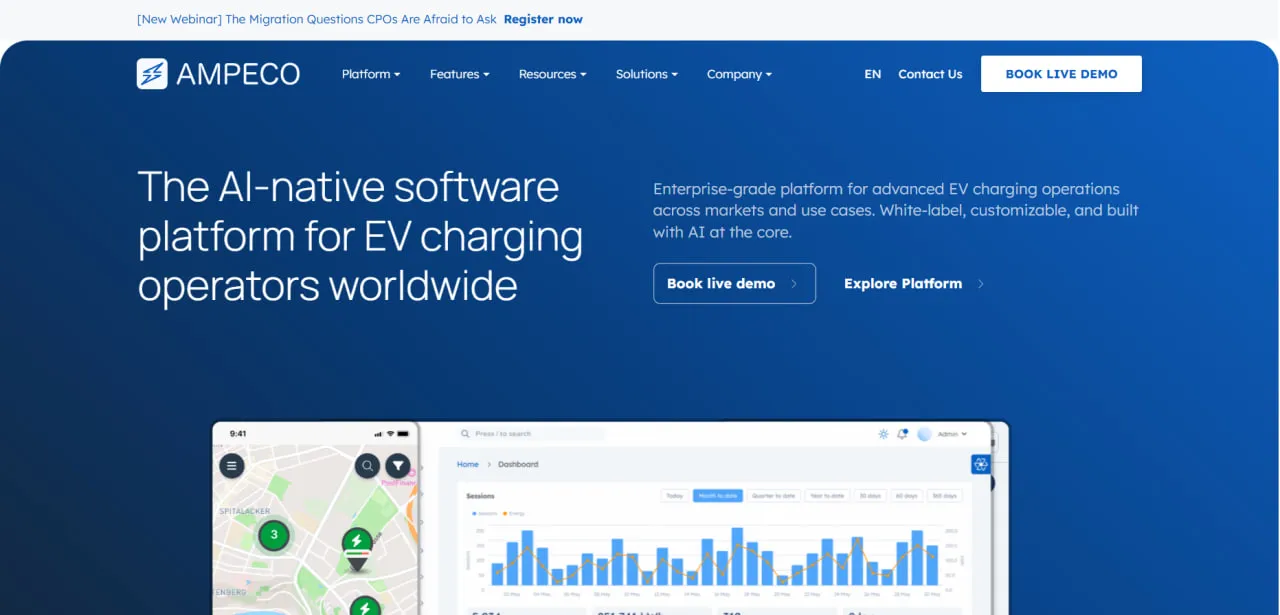
What Is AMPECO?
AMPECO is a cloud (SaaS) charge point management system (CPMS), founded in 2018. Besides CPOs, its customers include utilities, oil and gas companies, parking operators, carmakers and fleets. It can run CPO, eMSP and reseller businesses side by side with several branded apps; Swisscharge runs six on it.
Chargers connect over OCPP, and their live status flows into a web back office where operators set prices, manage energy loads and look after drivers and partners. More than 300,000 charge points in 70+ markets run on the platform, including those of Allego, Swisscharge and Wattif, whose network tops 45,000. Security certifications include ISO/IEC 27001:2022, 27017, 27018 and 27701, plus an annual SOC 2 Type II audit.
AMPECO is software for running an EV charging business under your own brand. It connects to any charger that supports the Open Charge Point Protocol (OCPP) and handles tariffs, payments, roaming, load management and the driver app. It suits charge point operators (CPOs) and e-mobility service providers (eMSPs) that want to keep their brand, customer data and choice of hardware, from start-ups to multi-country networks.
It is not for site hosts or charger owners who want someone else to run their chargers: AMPECO sells only software and does not own chargers or act as a CPO. Nor is there a cheap self-service plan: no public prices, no free trial, and every launch is a guided onboarding. At sites with solar, it can charge cars from surplus PV before drawing grid power, but it does not monitor the PV system.
Pros and Cons
Pros
- Start-ups launch on the same platform that runs 20,000+ charge point networks, so growth needs no re-platforming.
- The operator owns its brand, drivers and payment flows; AMPECO runs no charging network of its own to compete with.
- SOC 2 Type II and ISO 27001 reports speed up security reviews in utility and enterprise procurement.
- No lock-in: operators choose and switch charger makers, roaming partners and payment processors.
- Load management fits more chargers on an existing grid connection, and demand response adds revenue.
- 99.95%+ annual uptime per tenant, according to an AWS case study.
- Part buy, part build: in-house developers extend the platform via the API while AMPECO maintains OCPP, roaming and payments.
Cons
- No published prices plus one-off onboarding fees make a small operator’s business case hard to model up front.
- AMPECO’s protocol page lists OCPP up to 2.0.1; OCPP 2.1 support is not confirmed yet.
- No instant self-service start: go-live is a guided onboarding project, which AMPECO says takes about 4–6 weeks for a white-label launch.
- One full product with no lighter tier, so small teams still need training on a feature set built for multi-country operators.
Features
White-Label Driver Applications
iOS and Android apps in the operator’s logo and colors for finding stations and paying; ISO 15118 Plug & Charge starts a session without an app or card.
Energy Management
Dynamic Load Management (DLM) shares a site’s grid connection among chargers, vehicle-to-grid (V2G) lets cars feed power back, and demand response shifts charging to grid signals. At sites with PV, surplus solar can charge cars before grid power is drawn.
Hardware-Agnostic Connectivity
OCPP 1.5, 1.6 and 2.0.1, with ready integrations for 200+ charger makers and 400+ models.
Automated Billing and Flexible Tariffs
Prices per kWh, minute or time of day, idle fees and subscriptions, set per customer group, location or EVSE; receipts and invoices are automatic.
Roaming Management
Links to the Hubject and Gireve hubs, or peer-to-peer to other networks, over the Open Charge Point Interface (OCPI) and OICP.
Partner and Fleet Management
Site hosts, sub-operators and fleet customers get their own logins and permissions; revenue shares and fees are calculated in monthly settlement reports.
Predictive Maintenance and Diagnostics
Real-time fault alerts, self-healing routines that clear common charger faults automatically, and the CoOperator AI agent, which analyzes failed sessions on request.
API-First Architecture
A REST API lets the operator’s developers add features, embed charging in their own app or feed CRM and ERP systems; the operator owns the IP of what it builds.
AMPECO Pricing
Prices are not published; AMPECO quotes after a scoping call or product demo.
AMPECO’s own guide to CPMS costs lists the usual fee types, without amounts: one-off onboarding and roaming setup fees, then platform subscription, per-connector and transaction fees. AMPECO says it sells one full product with no tiered packages or feature gating and takes no transaction fees itself; the recurring bill grows with the number of connected charge points.
Integrations
Many integrations come as ready-made marketplace apps that need no custom development:
- Payment Integrations: Stripe, Braintree and Rapyd out of the box, a custom link to a local gateway, and card terminals at chargers.
- Energy Management: DREEV for demand response, Nord Pool and Octopus prices for dynamic tariffs, and OpenADR 2.0 for utility programs.
- Fleet and Telematics: Links to telematics and fleet software to plan charging around vehicle schedules, plus home-charging reimbursement for company cars.
- API and Webhooks: Public APIs, webhooks and Kafka event streaming send charger, user and transaction events to other systems in real time.
- Cloud Infrastructure: Runs on AWS (Amazon RDS, ECS) in eight regions.
How to Set Up AMPECO
- Book a demo and talk to the sales team to define your business requirements and network scale.
- In a discovery phase, settle the integrations and branding assets you need; AMPECO can build a proof of concept first.
- Finalize the commercial agreement.
- Work with AMPECO’s implementation team to connect your chargers, which it tests for free; migrations from another CPMS run through a proxy, so chargers stay online.
- Send your brand assets; AMPECO applies them and publishes the apps on Google Play and the App Store.
- Train your staff and go live.
How to Use AMPECO
Operations staff work in the web back office. The day usually starts on the operations dashboard, which flags chargers that are offline or reporting errors; from there they can reset a charger, unlock a stuck connector or change its availability remotely instead of sending a technician.
Finance teams track revenue by tariff and region, with payment processor, roaming and energy costs broken out. Energy managers set power limits per site and respond to peak demand signals from the grid. Fleet customers schedule charging around shifts, and reporting tools turn session data into performance analytics on utilization and driver behavior.
What You Can Manage with AMPECO
- Driver Accounts: Profiles, user groups, RFID tags, balances, vouchers and charging history.
- Network Monitoring: Live charger status, error logs and alert routing.
- Tariffs and Billing: Bulk tariff changes, monthly billing for apartment residents and corporate billing to partners.
- Energy Loads: Power limits per group of chargers, adjustable through the API by a building energy management system.
- Roaming Agreements: Terms negotiated directly with each partner, with no AMPECO intermediary.
- Hardware Configuration: Charger settings, charging profiles and bulk firmware updates.
- Analytics Reports: Revenue, energy use in kWh and the energy mix behind each tariff.
FAQs
What does AMPECO do?
AMPECO sells cloud software for running EV charging networks. It connects to chargers over OCPP and handles tariffs, payments, roaming, load management and white-label driver apps; it does not own or operate chargers itself.
Who is AMPECO best for?
Charge point operators and eMSPs, from start-ups to multi-country networks, plus utilities, parking operators and carmakers that run charging. It suits neither site hosts who want someone else to run their chargers nor operators looking for a cheap self-service plan.
Is AMPECO free?
No. There is no free version or self-service trial; you start with a demo, then sign up for a paid subscription.
How much does AMPECO cost?
Prices are not public; quotes follow a demo. Expect one-off onboarding fees and a recurring fee that grows with the number of charge points. AMPECO says it has no feature tiers and charges no transaction fees.
What are the main limitations of AMPECO?
The barriers come at the start: no public pricing, onboarding fees, a guided launch of about 4–6 weeks and a feature set that needs trained staff. That rules it out for individual charger owners and small operators wanting cheap self-service.
What are the best alternatives to AMPECO?
The closest like-for-like options are Driivz, GreenFlux and Virta. Monta publishes per-socket prices, which helps smaller operators budget. In the US and Canada, EV Connect, part of Schneider Electric since 2022, targets site hosts, fleets and utilities.

