

What is Ampcontrol?
Ampcontrol is a cloud charge point management system (CPMS) with energy management built in. Chargers, vehicles, building meters, solar inverters and batteries are monitored and controlled from one web dashboard.
Solar and battery storage are part of the optimization, so charging can follow PV output; Lidl Netherlands reports 22% higher solar self-consumption at its distribution centers.
It is not meant for homeowners or sites with a handful of chargers, and it is not a PV tool: there is no system design or solar asset management.
When an electric truck or bus fleet plugs in after a shift, a depot can exceed its grid connection or charge at peak tariffs. Ampcontrol splits the available power between chargers, caps peak demand and moves charging that can wait to cheaper hours.
It is built for fleets that charge at their own depots (trucks, transit and school buses, rideshare cars, port vehicles) and for the charge point operators that run such sites.
Pros and Cons
Pros
- Runs more chargers than the grid connection would normally allow
- Instant email and text alerts on charger and session errors
- Plans charging around each vehicle's next departure
- Cuts demand charges with peak capping and tariff-based scheduling
- 24/7 in-house support team
- OCPP 2.0.1 certified, 30+ tested charger brands: no hardware lock-in
- ISO 27001 and SOC 2 Type 2 certified; 99.995% uptime (vendor figure)
Cons
- Overkill for homeowners and businesses with a few chargers
- No public prices; budgeting starts with a sales call
- No free trial or self-serve sign-up
- Live load balancing during internet outages requires the AmpEdge on-site controller
- Not a solar tool: no PV design or solar asset management
Features
Smart Charging Optimization
The platform shares out the available power by each vehicle's departure time, state of charge and priority, then moves charging that can wait into cheaper time-of-use, day-ahead or spot-price hours.
Load Management System
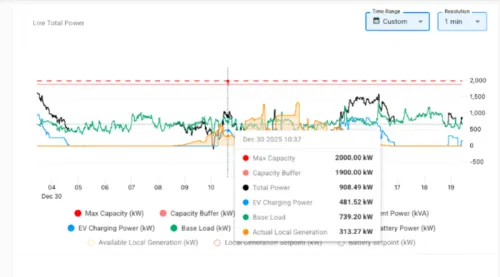
Ampcontrol keeps all chargers plus the building load within the grid connection limit. The load management is UL 60730-1 certified, so a site can oversubscribe its connection instead of paying for a grid upgrade.
Real-time Monitoring
The dashboard shows live sessions, energy use and charger status. The Alert Center sends email or text alerts when a charger or session fails, keeps error reports, ranks chargers by failure rate and can push alerts to ticketing tools via the API.
Fleet Integration
The AutoScheduler takes each vehicle's state of charge, GPS position and arrival and departure times from telematics, a transport management system or a route-plan upload, and plans charging for its next run. Priorities, schedules and energy limits can also be set by hand.
Reporting and Analytics
You can generate reports on charging sessions, energy consumption, OCPP data and alerts, and download them as CSV. Charge Ready utility-program reports and LCFS credit reports are also available. The dashboard keeps five years of history.
Ampcontrol Pricing
Ampcontrol does not publish prices or offer a free trial; each customer gets a quote after a demo.
Pricing depends on:
Number of chargers connected
Size of the EV fleet or site
Required features and integrations
Level of support and service
Ask whether the quote includes 24/7/365 charger monitoring and the driver help desk, which Ampcontrol offers as a service. If Ampcontrol sells LCFS credits for you, it keeps a small management fee.
Integrations
Besides OCPP chargers, Ampcontrol connects to:
- Fleet management systems (telematics)Pre-built connectors for Geotab, Webfleet, Samsara, Volvo and Scania supply vehicle location and state of charge.
- Utility programs and energy pricesOpenADR demand-response signals, V2G events and live tariff and market prices.
- Payment and billing solutionsPayter and Nayax terminals, RFID, Plug & Charge (ISO 15118), custom rates and idle fees, and B2B invoicing based on energy use.
- Energy meters, solar and batteriesBuilding meters, solar inverters and battery storage (BESS), connected on site through the AmpEdge controller over Modbus TCP/IP or MQTT.
- API-based custom enterprise toolsA REST API with PubSub event streams feeds charger, session and alert data into in-house systems.
How to Set Up Ampcontrol
Ampcontrol's team handles onboarding and charger commissioning; it says a site can be integrated within one day.
1. Create an account
Request a demo on the Ampcontrol website. The team reviews your fleet and site, shows the platform and then creates your account.
2. Configure infrastructure
Connect the chargers over OCPP and add vehicles and site power data.
3. Set energy strategy
Set vehicle priorities, schedules and energy limits.
4. Integrate systems
Connect fleet software, billing systems, or energy platforms if needed.
5. Test the system
Run initial charging sessions to validate configuration and performance.
6. Go live
Activate full operations and monitor through the dashboard.
FAQs
What is Ampcontrol used for?
Running EV charging at fleet depots and commercial sites: charger control, load management and departure-based charging schedules.
Is Ampcontrol suitable for home charging?
No. It is built for business charging sites and sold by quote. Fleets can, however, use it to reimburse drivers who charge company EVs at home, with payouts handled through payroll.
Does Ampcontrol work with all chargers?
It supports most OCPP-compliant chargers: OCPP 1.6J and 2.0.1 (2.0.1 certified by the Open Charge Alliance), with models from 30+ brands tested, including ABB, Alpitronic and Kempower. Check yours against Ampcontrol's compatibility list.
Can Ampcontrol reduce energy costs?
Yes, by moving charging to cheaper tariff periods and capping peak demand. Rideshare operator Revel reports a 45% cut in its monthly demand charges.


